
How Tonka toys cost the Sega Master System the 8-bit war
For its 30th anniversary, we look back at how Sega handed its 8-bit console to a toy truck company in North America, while quietly conquering the rest of the world.
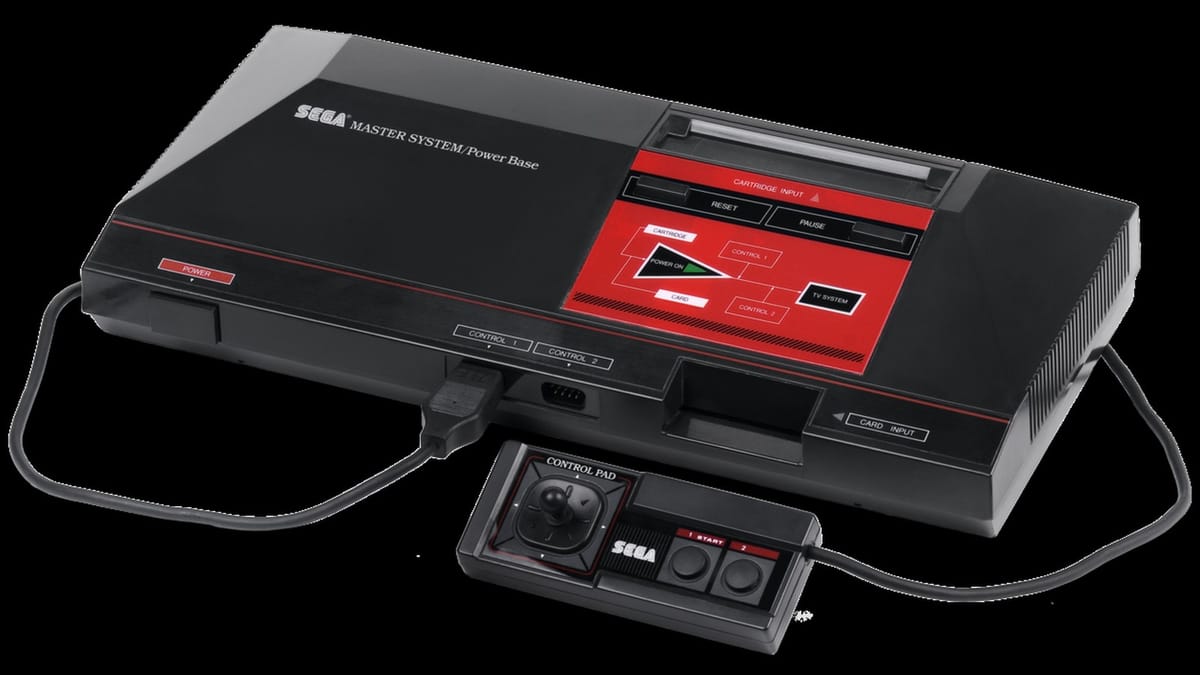
October 1986 brought the Sega Master System to North American shelves. We're hitting its 30th anniversary, and looking back, I didn't have one as a kid. You had a Nintendo Entertainment System, or maybe a TurboGrafx-16. Though Sega's console was technically more powerful than the NES, most of its games weren't as fun to me. The hardware had a Zilog Z80A processor running at 3.58 MHz and could display 32 colors on screen. Nintendo had a weaker chip, but they had Mario.
The console actually started life in Japan as the Sega Mark III. Released in October 1985 for 15,000 yen, it was the third iteration of Sega's SG-1000 hardware line. Sega engineers Hideki Sato and Masami Ishikawa designed the custom graphics chip based on their System 2 arcade boards, hoping to bring games like Hang-On and Space Harrier into the living room with as little compromise as possible. When Sega of America formed in 1986, they redesigned the Mark III's shell into the angular black and red Master System we got in the States. The $200 launch bundle included two controllers, a Light Phaser gun, and a cartridge with Hang-On and Safari Hunt. The console even had a slot for credit-card-sized Sega Cards alongside the standard cartridge port.
Sega needed a way to break Nintendo's grip on the United States. Nintendo held strict contracts with third-party developers, preventing companies like Capcom and Konami from putting their games on competing hardware for two years. Sega had to rely on its own arcade ports and a tiny handful of partners like Activision and Parker Brothers to build a library. By the end of 1987, Sega realized they needed help with distribution. They looked for a partner with a strong retail network and deep pockets.
They sold toy trucks
In July 1987, Sega handed the North American marketing and distribution rights to Tonka. The Minnesota-based company built an empire on steel dump trucks and construction toys. Prior to signing with Sega, Tonka had zero experience selling video games or consumer electronics. It went exactly how you'd expect.
The timing was terrible. A month after taking on the Master System, Tonka bought Kenner Parker Toys for $555 million. The massive debt from that acquisition left them bleeding cash, reporting a net loss of $7.5 million by the end of the year. They didn't have the budget to fight Nintendo, who was spending upwards of $20 million a year on advertising.
Tonka also controlled which games made it to American store shelves. They routinely passed on localizing the best-selling titles from Japan and Europe. Instead, American players got stuck with games like Cloudmaster. The documentation of this era on Sega Masters shows a company completely out of its depth. Tonka did manage to get the console into more toy aisles, but they had no idea how to sell the software. By August 1989, Sega had seen enough. They took the American rights back, just in time to launch the 16-bit Genesis. The Tonka experiment moved fewer than a million consoles over two years.
Winning the rest of the world
The Master System failed in the United States, but it dominated almost everywhere else. Sega's 8-bit hardware found massive success in Europe and Australia. In the United Kingdom, Virgin Mastertronic positioned the console as a superior alternative to the ZX Spectrum and Commodore 64. They sold 150,000 units in the UK in 1990 alone.
The real stronghold was Brazil. In September 1989, a Brazilian company called Tectoy launched the Master System in South America. Tectoy understood their local market perfectly. Because Brazil had strict import taxes on electronics, Tectoy assembled the consoles domestically. Nintendo didn't officially enter Brazil until 1993, leaving the market wide open. Tectoy eventually claimed 80 percent of the Brazilian video game market.
As detailed by Munib Rezaie in The Munib Archives, Tectoy even worked around Brazil's massive inflation and infrastructure problems. When phone lines cost $5,000 to install, making a traditional customer support call center impossible, Tectoy created a minute-long television spot called Master Dicas to broadcast game hints to players instead. The console never really died in Brazil. Tectoy kept manufacturing licensed variations of the hardware for decades, reaching an installed base of over five million units by 2012.
The Sega Master System sold 13 million units worldwide, plus another 8 million licensed variants in Brazil. It lost the United States because a toy truck company didn't know how to sell arcade ports, but that failure taught Sega exactly how to handle the Genesis.
Comments ()