
Mamoru Oshii's 30th Anniversary Ghost in the Shell Interview: The Complete Translation
Ghost in the Shell director Mamoru Oshii sat down for a 30-question interview to celebrate the film's 30th anniversary. We translated the whole thing, including his thoughts on cyberpunk, the human soul, and his 10,000 hours in Fallout 4.
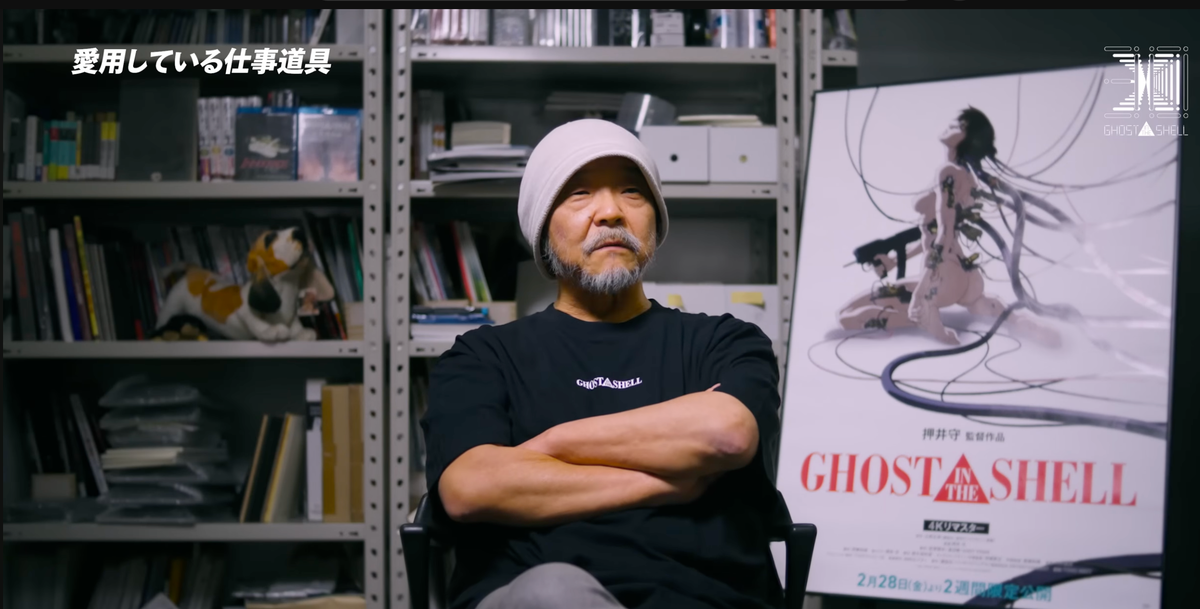
The official Ghost in the Shell YouTube channel just dropped a 30-question interview with legendary director Mamoru Oshii to celebrate the 1995 anime film's 30th anniversary. It is exactly as weird, blunt, and fascinating as you would expect from the man who helped define modern science fiction. I have been waiting for something like this, and watching a master filmmaker casually complain about video game updates while discussing the nature of the human soul is pure internet gold.
If you are somehow unfamiliar with Oshii, he is the mastermind behind the original 1995 Ghost in the Shell, Patlabor, The Sky Crawlers, and Urusei Yatsura. He is basically anime royalty. He is also famous for his deep philosophical musings, his absolute obsession with basset hounds, and his refusal to sugarcoat anything about the animation industry.
This new Q&A session is packed with incredible moments. Oshii admits he has logged over 10,000 hours in Fallout 4, complains about mod updates ruining his save files, declares that he wants cyborg organ implants so he can drink more, and casually dismisses the entire cyberpunk genre as something he does not even care about. He also drops some surprisingly touching thoughts on aging and finding happiness in a quiet life.
You absolutely need to go watch the original Japanese video to see his deadpan delivery for yourself. Before we get to the text, here is a quick note on the translation.
Translator's note: This is Pants Pants Revolution's English translation of the auto-generated Japanese transcript. The transcript is auto-generated and some passages were unclear. Those have been rendered as faithfully as possible, but readers who speak Japanese should watch the original for full accuracy.
Pre-interview monologue
Oshii opens before the Q&A begins: "Fiction and reality (I don't make films with that as a binary opposition). I think it's all fiction. I'm not that interested in cyberpunk, honestly haven't read much of it. As a director, since I can't do anything without work, all I can do is play games and wait."
Introduction
Host: Good morning. This is the director of Ghost in the Shell.
Host: Today, we will answer 30 questions from viewers.
Oshii: Sure, let's do it.
The 30 questions
Q1: What did you have for breakfast recently?
Oshii: Bread. It's too simple, isn't it? [laughter] Well, there's no time in the morning. I ended up going with bread. I don't particularly love bread, but that's what it came to.
Q2: How often do you go to ramen shops?
Oshii: On average, about four times a week. At peak times, I'm there every day until late. If there's one on my way somewhere, I'll basically eat there.
Q3: What is your favorite food?
Oshii: I used to stop eating eggs because of health concerns, but then I started feeling a little sad about it. These days it's eggs, I think.
Q4: Do you have a favorite shop?
Oshii: I have a few favorites, but about half of them have closed down.
Q5: What hat brand do you wear?
Oshii: I have no idea what brand it is. I've never checked. I probably own about 230 hats. They just pile up. In summer I wear different hats because it's hot, but in the end, you only really use three or four of them. I wash them properly. In winter it's about two or three knit hats. They're tools, and I love them.
Q6: What tools do you always carry?
Oshii: I don't carry many tools. I tend to borrow things on the spot. If I decide on specific tools, I always forget them. The one thing I always have with me is glasses. I've worn them for about twenty years now. Presbyopia. I use one pair for drawing storyboards and checking things, and a different pair for driving. Two pairs basically. I know the brand for these, well, I forget which one. [laughter] I forgot. But they're proper frames. Eyes are everything for me, so I put real effort into finding good ones. I also had a driving pair made. People around me tell me to stop driving, saying "you're at that age." I know people who've had accidents. If you stop driving, there's a theory that you lose your mind faster, so I keep at it, but nighttime is definitely harder. I always wear glasses at night. I also have sunglasses I really like. I forgot them today, didn't think it'd be this bright. I try to wear them whenever I'm on stage or presenting. I call them my 'intelligence glasses' because there's a theory they raise your intelligence stat. Like in Dragon Quest, they boost your INT a little.
Q7: Do you prefer dogs or cats?
Oshii: I love dogs, and recently I've also come to love cats. It took me a while to understand cats. Once I actually lived with them, I started to get it. I've lived with fifteen or more of them, five inside, three outside. You really can't understand cats until you live with them. Maybe it comes with age. They're difficult to hold. Probably only about 20% will let you, and roughly half will just try to run away. That's part of the fun.
Q8: What military hardware do you like?
Oshii: For Self-Defense Force vehicles, normal ones. I've actually filmed with them, so seeing them in action makes me like them more. Aircraft especially, you don't really understand them until you're near one. The F-2, once I got up close, I thought it had a surprisingly Japanese quality to it. I liked it quite a bit. I love things as objects, but whether I'd want to ride one into battle is a separate question entirely. The C-130 was great too. If I actually had to fly, I'd want a transport plane rather than a fighter. I also love airships.
Q9: What is the best movie you've seen recently?
Oshii: In theaters, well, I'm not sure if it counts as recent anymore. I basically like everything Christopher Nolan makes, but Tenet was great. Aside from that, I can't think of anything else, so that's probably it for recently.
Q10: What kinds of books do you read?
Oshii: I almost never read novels. Mostly history and criticism. Lately I haven't been reading new books at all. I've been re-reading things I read as a student. Things I didn't understand then, I understand now. Recently I've been struck by Kobayashi Hideo, literary criticism. My philosophy reading has dropped completely. Rather than following logic, I find myself enjoying the writing style itself. For prose, I've come back to old things, travel writing, the literary figures of an earlier era. I love Japanese writing with real flavor. Translations, fundamentally, are not interesting to me. Part of why I've drifted from philosophy is that the writing stops being enjoyable.
Q11: What game are you currently hooked on?
Oshii: I can answer instantly: Fallout 4. I've been playing it for eight years or more. When I checked Steam recently it said 8,000 hours, but I also played on PlayStation before that, so the total is probably over 10,000 hours. I'm still playing now. Death Stranding 2 just ended, so when that was running I was doing that, but it's over, and I had nothing else to do and went back to Fallout 4. There's nothing else I want to play right now. If Kojima-san releases something new, I'll play that. Otherwise it's Fallout 4. That's been true for about ten years. I did try PUBG once, got to about 250 hours, and had one miraculous chicken dinner, took a screenshot to commemorate it, but then I stopped. Online games aren't for me. I want to play games alone. I don't want to play with people I don't know. Getting my head blown off by some random person is deeply unpleasant. I also played Virtua Fighter back during Ghost in the Shell production, Virtua Fighter 2, and I quit after getting destroyed by a middle schooler. Fighting games are clearly not for me either. Shooters too, my reflexes aren't good enough, and I'm completely terrible at FPS games. Fallout 4 is just right. It's technically action, but there's the VATS system where you press a button and enemies go into super slow-motion. No matter how bad your reflexes are, you can basically win. Well, not always. But without that system, I probably couldn't have managed. And the ruins, wandering around with a dog and a rifle, that game was made exactly for my personal wishes.
Q12: What's your current status in Fallout 4?
Oshii: I've long since done everything there is to do, ran out of things to do four or more years ago. The DLC came out too. I'm playing in a half-modded state now. The new edition, I haven't played it. I knew intuitively before starting that it wouldn't suit me. Also, please don't change the version without asking. Do you know how hard it was to revert? The MODs stopped working, and suddenly some bald middle-aged man appeared who I'd never seen before. "Who the hell is this?" All my data was messed up. Please stop changing it without warning. It's their game and they can do what they want, but that really got me.
Q13: If cyborg implants were possible, would you want them?
Oshii: Definitely the implants, yes. Maintenance sounds annoying for actual prosthetic limbs, I mean. But internal organ implants? Absolutely. My internal organs are getting pretty worn out. Muscles I can maintain, but organs just deteriorate on their own schedule. I want something that lets me drink as much as I want and be fine. Or never need to sleep. Sensory augmentation would be fascinating too. When I was most obsessed with dogs, I really wanted a tail. A retractable one that you'd extend at home. The trousers situation would be complicated. Humans used to have tails, and the coccyx remains. Living creatures are probably more correct with tails. The cat-ear thing, not interested. Definitely tails. Overwhelmingly.
Q14: What has been your biggest hardship?
Oshii: Simply put: twice in my career I had no work. Once for about three years after Patlabor, and once for about three years after Sky Crawlers. It doesn't seem to correlate with how the work was received. Patlabor was called self-indulgent, which I accepted. But Sky Crawlers meant three years with nothing lined up. Actually longer, I was doing various small things, but essentially nothing. As a director, if there's no work, there's nothing you can do. The one thing that saved me, the only way to cope, was simply: games. Play games and wait. If I hadn't had that, it would have been very hard. That's ultimately how I got so deep into games.
Q15: What country would you most like to visit?
Oshii: I hate travel. I hate it, but for work and filming I've probably been to seventy or eighty countries. I've basically been everywhere, so there's nowhere I want to go anymore. Film festivals are exhausting. I can't see any films, no time, sometimes can't even eat properly. I'm done with film festivals, and I have no desire to go abroad. If I had to say, domestically, a hot spring. Lying there drinking beer. No real desire to see new things. Time travel is completely out of the question. Space, absolutely not. When I was young I wanted to go to Mars, see the actual scenery. But as you get older, those romantic ambitions prove themselves out. You start wanting comfort and calm. I want a flat emotional state. I don't want to be moved. Being moved is exhausting.
Q16: What are your thoughts on emotion and happiness?
Oshii: Young people love being moved emotionally. They watch movies and read manga to feel things. They may think life's greatest peak is finding a lover. Unfortunately, that's all an illusion. A human being's best life is living with calm, flat emotions, in peace. The Buddha probably said something along those lines. That's where I am now. As you age you stop being affected by things the way you were. When a dog dies and its owner weeps, I feel like I'm going to cry too. Movies where dogs are in danger, I turn them off immediately. I hate having my emotions manipulated. I want to drink when I want, smoke when I want, and live as an ordinary person with a flat emotional state. Desires have shrunk. Material wants are basically gone. I don't particularly care about eating interesting food. I just need mackerel. But actually, desires don't disappear, they become refined. What you truly need stays. That's wonderful. Young people are driven and wounded by their desires, the desire to be recognized, to be validated. It's fine if nobody evaluates you, as long as you can do what you want to do. In the end, my fantasy is: a 60,000-yen apartment, lying in a kotatsu playing games, one cat, and dying with the cat licking my face. That's probably happiness. That's probably the most correct way for a human to live. From that image, think backwards about what you actually need, and everyone might be a lot happier.
Q17: If you could have any character smoke in your work, who?
Oshii: Not Ishikawa, originally I had a different one in mind. I wanted to let every female character I've created smoke, but there are never many opportunities. People object. I personally love watching women smoke. Sky Crawlers was heaven for that, the whole cast was smoking. The one regret is the maintenance woman. I wanted her to smoke but missed the chance. The best thing about Sky Crawlers was that everyone smoked freely and nobody really complained about the characters.
Q18: Do you think about romantic relationships between your characters?
Oshii: Almost never. I think about what characters eat, what they do, but romance and family relationships, I fundamentally dislike writing. So I haven't done much of it. What I do always create is one character where anything goes. "This one, I can do whatever I want to them." There's stress in writing, and if everyone has to have dignity and morality, it gets exhausting. So I always make sure there's one character where any foolishness is permitted. If no one in the source material fits that role, I'll just invent one. It's like the "annoying glasses character" who is not omnipotent or invincible, just someone where any behavior is acceptable. In Ghost in the Shell, since basically everyone is sharp and capable, it's difficult. That kind of character is hard to find.
Q19: What was your original concept for Motoko Kusanagi?
Oshii: My first thought was: a woman who doesn't need men. There's a recurring thing in fiction where even the overwhelmingly powerful female protagonist has a supportive male figure, a handsome escort type who appears to help, explain things, make the story easier to follow. I call these "big brother characters." I hate them. I wanted a protagonist who operates entirely alone, on her own judgment, accepting the risk herself. No need for advice. That's what becomes a hard-boiled character. A character who lives by their own personal moral code, their own rules, that's my favorite type. So I thought: an absolute egoist, a creature entirely built from self-preservation instinct. That seemed interesting. A very troublesome woman, that's a category I'm quite fond of, fundamentally. Obedient women, clever women, high-handed types, I dislike them all. They're all looking at men. So not "independent" exactly, more aggressive, combative. That became Motoko. The original manga version has slight differences. In the anime, that translated into something unexpected. Young men, I figured, would find her somewhat off-putting. Meanwhile, she actually resonated strongly with female viewers. I thought: of course. That support-character boyfriend trope, I've always suspected most women actually hate it.
Q20: Why did you make Motoko appear naked in Ghost in the Shell?
Oshii: I thought about it a lot. Normally you'd think: she'd just be totally nude. The source material went there, and that's probably what everyone expected. But if you handle it straightforwardly, it runs into content issues. The poster was also rejected. These days people are more sensitive. Most of my work lands around R15, usually for violence rather than sexual content. If you think about it seriously, she has gloves but with open fingers, face exposed. What kind of mechanism makes that work? Since it's a cyborg, the skin itself is covered in optical camouflage. But then what about the hair? Logically there should be gaps, like an invisible man. If a transparent person existed, their eyeballs would be transparent too. So it's really a kind of wish fulfillment. The thermoptic suit is like a magic cloak, the near-future version of the magic cloak. That's actually being researched right now, but mostly for hiding tanks and aircraft. Using it on humans directly, that's eternal wish fulfillment. What would you do if you were invisible? That's the oldest daydream, middle school level. It keeps appearing, transformed, throughout all storytelling, like eternal symbols.
Q21: What superpower would you want?
Oshii: I used to want to be a psychic, but now that just sounds exhausting. What I do want is a warp. Teleportation. When it's raining and I don't want to go to the stadium. The "Anywhere Door" from Doraemon is actually easier to imagine than a warp, seems less physically demanding. I want the Anywhere Door.
Q22: How did you feel when Ghost in the Shell became a major hit overseas?
Oshii: When it came out in Japan, the reception was mild. People said it was difficult, hard to understand. Then in North America it became a massive hit, sold enormously. Suddenly a huge number of people wanted to interview me. And I remember at the time thinking: I can't let this go to my head. People around me also warned me, "be careful, you'll get spoiled." Once you're on stage and something gets noticed, a spotlight gets put on you. But when you leave, you walk back yourself. You can't stay on stage forever. I've always kept that in mind. I kept my lifestyle and habits exactly as they were. People told me to dress better, said my appearance wasn't appropriate. I didn't listen. And I don't search for myself online, never have. Partly to avoid getting too proud of myself, and partly because half of it is going to be insults. Being on stage means being the defendant in a trial. That's the director's profession. Actors too. I don't want to read about myself burning up online. I know what I've done wrong, and I did it anyway. So: assume half the world is saying bad things about you, and live accordingly. Which is why I say what I want to say. One of my book titles says it explicitly: "A director's job is to make half the world angry."
Q23: Some say you have a cute personality, do you agree?
Oshii: Me? Cute? I don't follow what the world thinks of me, so I have no idea. But I think it's plausible. At an awards ceremony overseas, someone called me "funny." That surprised me. I make a lot of jokes. When I'm with people, giving talks or speeches, roughly half of what I say is jokes and nonsense. Partly because the mood is better, and also because I genuinely don't dislike making people happy. I'm convinced that the ability to play the fool is equal to human intelligence. People who can't play the fool are unhappy. People who think they're smart and refuse to act like idiots, they fall the hardest. I've met many directors, Japanese and international, across all of anime. They all love stupid jokes. The ones who refuse are unsuited for film, I think. Directors are fundamentally irresponsible people.
Q24: Is it a misunderstanding that Ghost in the Shell is cyberpunk?
Oshii: A complete misunderstanding. I'm not interested in cyberpunk. Haven't read much of it. Honestly, not interested. In terms of SF, I prefer mecha and cyborg stories. Cyborg and cyberpunk might seem compatible but I actually think they're fundamentally opposed. Ghost in the Shell, I didn't think of it as cyberpunk, so I was surprised when people called it that. I love hard-boiled stuff. Cyberpunk doesn't resonate with me. I haven't even touched the Cyberpunk video game. The thing is, I have no desire to live in a garbage dump. Someone once told me there are young people who want to live in garbage dumps, they think that's cool. That's what cyberpunk is, essentially. Dirty subways, slums, a certain type of young man finds that appealing. In Fallout 4, ninety-eight percent of the people are scoundrels. If you turn the corner carelessly, you'll get your head blown off. But that's because it's a nuclear wasteland, which is somehow forgivable. In a technologically advanced society, cyberpunk is basically cosplay to me. That's why I'm not interested.
Q25: Do you believe in the concept of character growth?
Oshii: That's the Bildungsroman, the coming-of-age story. Youth grows up. It started in literature and film followed. Life drama. To be honest, I'm not that interested in it. I was once told by a teacher that in TV series, if the protagonist hasn't changed by the final episode, you've failed, that you spend a year growing together with the audience. Character growth is the barometer of how hard the writer and director worked. I thought about that. It has merit. But in practice, the very first thing I directed, Urusei Yatsura: Beautiful Dreamer, did Ataru change even one millimeter? No. No matter how many years pass. And I realized I actually like that pattern. Ultimately, humans don't change. I think of that not as resignation but as salvation. What looks like "growth" or "evolution" is actually specialization. You become more specifically yourself. I haven't changed since high school. My protagonists haven't grown either. Motoko is Motoko, arrogant, selfish, every time. Sky Crawlers tried to challenge that, but even then it loops back. The person is reborn but returns to the same. Humans don't change. Within that, how do you find happiness, that's the question that matters.
Q26: What is your worldview?
Oshii: My worldview, and my sense of society, it's all delusion. I mean that sincerely. Even most of what I've seen and confirmed is heavily colored by personal delusion. About eighty percent of it. There's a strong desire to reset everything. After the reset, what world would I want? One where individuals can live as individuals, that's basically enough. That might sound like a vision or ideology, but it's really a vision of human nature. How the scenery looks, how technology develops, those are secondary. What matters is the way humans exist in that world. My clearest expression of that worldview was probably Sky Crawlers, surprisingly. And the word "worldview" itself is greatly misunderstood, I think.
Q27: Do you work from the opposition of fiction versus reality?
Oshii: That's a misunderstanding, one of many the world has about me. I don't make films with fiction and reality as a binary. I think it's all fiction. [laughter] I'm a one-dimensional thinker in that sense. Framing it that way makes it seem clearer for a moment. I feel like people understand a little better when I say "I treat reality as fiction." But the door only opens halfway. That's not quite right either.
Q28: What are your thoughts on death?
Oshii: Someone said something wonderful, "death does not exist." The human brain is simply not built to process it. You cannot experience your own death. The stoics said the same thing. Everyone who dies around you dies as a stranger. That's the human condition. You can call it soul, ghost, spirit, the word Ghost is the same. Humans cannot narrate themselves. You always exist as other. And the self is also part of that otherness. More simply: how many of your twenty-four hours are you actually consciously aware of yourself? Maybe one hour. The rest you're operating as an automaton. And if you weren't, if you had to consciously think about walking, you couldn't walk. "To walk I must first advance the right foot..." If you actually think that, you freeze. The soul, in purely philosophical terms, only exists as a thought experiment. Soul would be nice to have, that's probably how I actually feel. I'm non-religious but not an atheist. Non-religious and atheist are completely different. I believe there are presences beyond the human. Moments of experiencing something greater. But to think about existence purely as logic is to fall into a trap. Religions exploit that trap. Whether I exist, whether consciousness proves existence, is permanently unverifiable. Thinking about it is pointless. I just hope it doesn't hurt. I imagine I'll disappear like falling asleep. I want that. My ideal death, honestly: dying by the roadside, with a dog licking my face. As one small part of the world, quietly disappearing. That's actually kind of cool. That's the best ending. Don't think about this too much when you're young. It's pointless. There's no answer.
Q29 and Q30
[Note: Questions 29 and 30 were not clearly distinguishable in the transcript due to rapid speech at the end of the session. If anyone can help with this, I'll update the article.]
Closing
Host: Thirty questions answered. Thank you very much. How was that?
Oshii: I hope everyone found it interesting, then I'm happy too. Ghost in the Shell, it's been thirty years now. I'm amazed it's lasted this long. I hope it continues going forward. And as always, please subscribe to the channel. [laughter]
Comments ()