
RPCS3 makes 80% of the PlayStation 3 library playable on PC
The open-source PlayStation 3 emulator has crossed the 80% compatibility threshold after new accuracy updates to its CPU, GPU, and PS Move code.

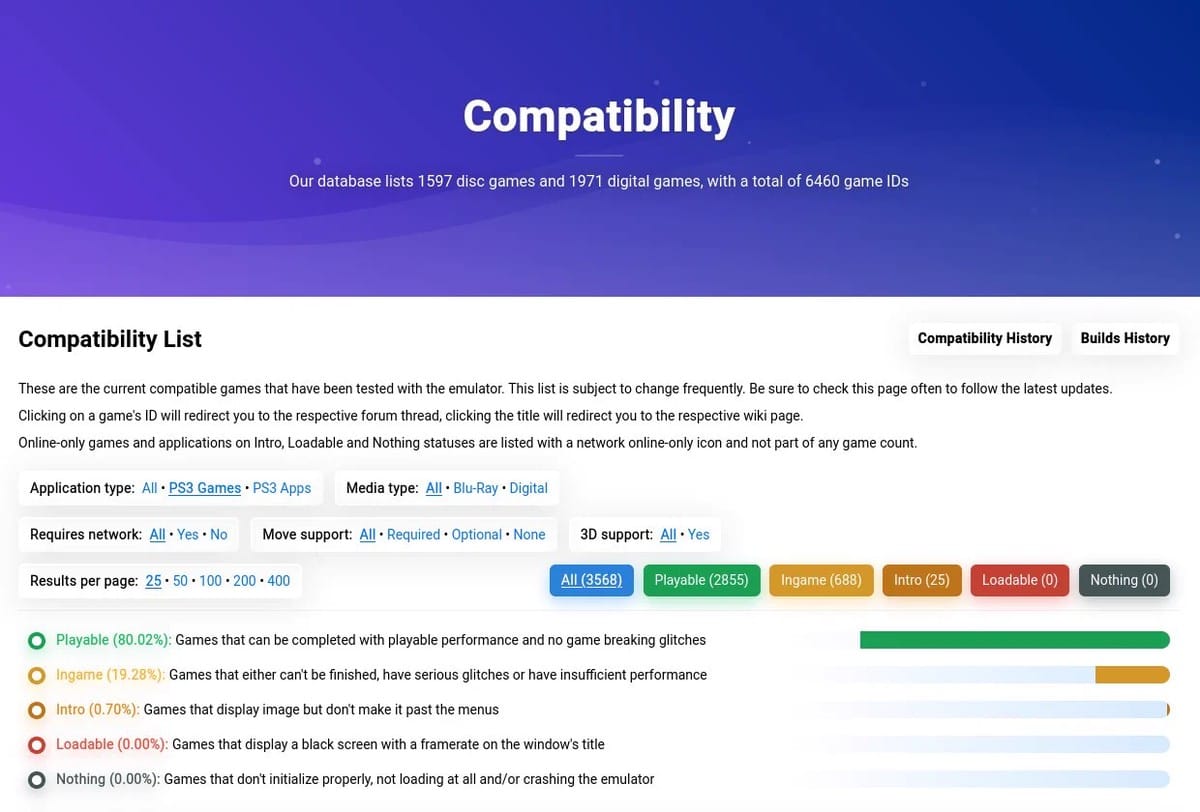
The open-source PlayStation 3 emulator RPCS3 has officially pushed 80% of the console's software library into its Playable category on PC. Reached on October 21, the milestone covers 2,855 out of 3,568 cataloged titles (80.02%, to be exact) and follows a series of accuracy improvements to the emulator's CPU, GPU, and PlayStation Move handling.
RPCS3 uses strict criteria for its compatibility tiers. A game only earns the Playable label when you can finish it from start to finish with steady framerates and zero game-breaking bugs. Right now, the project has zero games stuck in the "Nothing" or "Loadable" tiers, where software either fails to boot or freezes on a black screen. Everything outside that 80.02% playable chunk sits in either "In-Game" (19.28%) or "Intro" (0.70%). That is a rapid jump from January 2026, when 2,558 games were playable, and even from July 15, when the team crossed the 75% mark.
Taming the Cell processor and Gran Turismo
Programmers DH and Hykem started the project on May 23, 2011, roughly five years after the PlayStation 3 launched in North America at its infamous $499 and $599 price points. For years, conventional wisdom held that Sony's seventh-generation machine was too weird to emulate smoothly on standard x86 consumer hardware. The bottleneck was the Cell Broadband Engine, an asymmetric processor built around a PowerPC-based Power Processing Element (PPE) paired with eight Synergistic Processing Elements (SPEs), working alongside Nvidia's RSX Reality Synthesizer GPU. Current builds available on the RPCS3 download page run across Windows, Linux, macOS, and FreeBSD, relying on an LLVM-based CPU recompiler and a Vulkan graphics backend to translate that complex silicon without needing a supercomputer.
First-party games that leaned hard on the Cell and RSX have always been the toughest nuts to crack, and Polyphony Digital's racing sims were among the worst offenders. Earlier in October, contributor Yahfz patched out the last remaining graphical bugs in 2010's Gran Turismo 5, a game that sold nearly 12 million copies on original hardware. That texture cache fix restored missing shadows, corrected mirror lighting, and stopped car windows from flashing white. Only raw performance on recommended PC specs keeps it out of the Playable tier now. A few days later on October 8, graphics developer kd-11 fixed a corrupted rear-view mirror bug in 2013's Gran Turismo 6 (affecting versions up to 1.05) by using frame-buffer aliasing bias to sort out overlapping color and depth tags.
Sony's backwards compatibility blind spot
Seeing unpaid volunteers untangle Polyphony Digital's rendering quirks on PC makes Sony's refusal to handle its own history look even worse. If only Sony listened to many, many youtubers and reddit threads about wanting backwards compatibility, hackers likely wouldn't have taken the time to jailbreak the PS5. Before the PS5 launched there was rumor of full backwards compatibility. Everyone was really excited. Then, nothing.. And now look where we are.
Instead of slipping an old disc into a modern console in the living room, players who want to revisit seventh-generation exclusives at stable framerates have to rely on an open-source PC project. I'm curious to see whether Gran Turismo 5 gets the CPU optimizations it needs to cross the finish line before the end of the year, especially since the team says more updates are coming before 2026 wraps up.

Comments ()