
MD Engine adds standalone tools and raster effects in new update
Two Black Cats has updated its Sega Genesis development environment with standalone pixel and audio tools, plus native hardware effects.
Two Black Cats has released version 1.1.0 of MD Engine, bringing standalone pixel and audio tools alongside native hardware effects to the Sega Genesis development environment. The update is available now for Windows, macOS, and Linux users.
We've covered MD Engine a few times before. The toolchain launched on September 7, and it lets creators build authentic 16-bit Sega Genesis software without writing assembly or C code. It compiles games to run natively on original hardware, flash carts, and modern operating systems. The software costs $19.99 on Steam and the developer's storefront.
Two Black Cats formed in 2024 and specializes in porting contemporary games to vintage hardware. Before launching MD Engine, the studio developed titles like Square Brothers, Inkventure, and Prisonela MD. They built this toolset to streamline their own cartridge releases and flash hardware projects before packaging it for the public.
The update fixes several core editor issues, including broken undo states, incorrect math expressions, and projectile culling, according to Two Black Cats. Windows users will also find that the export window no longer accepts input when it loses focus.
Mini Painter gets a standalone mode
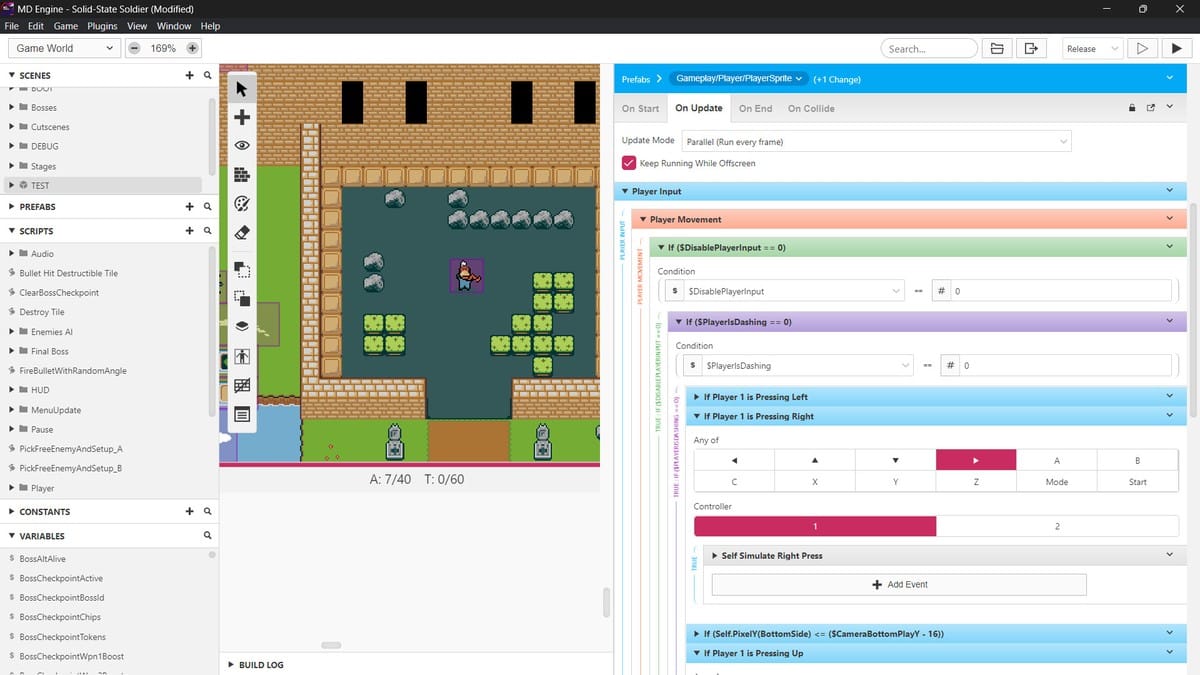
The engine includes bundled pixel and audio creation utilities called Mini Painter and Mini Tracker. With this update, developers can launch both as standalone applications by passing specific command-line arguments to the main MD Engine executable. You don't have to open a full game project just to edit a sprite or tweak an audio track.
The update also exposes more of the Motorola 68000 hardware capabilities. The developer added native support for hardware-level line-scroll waves, raster gradients, and palette cycling. Games like Sonic the Hedgehog originally used line-scrolling to create the illusion of water moving in the background, while palette cycling handled glowing lights and flowing waterfalls. By making these native engine features, creators can replicate those 1990s visual styles without writing custom rendering routines.
A new 30 FPS mode and XGM2 audio fixes
Developing for the Sega Genesis involves strict resource budgets. The update introduces a new Shared Sprite Engine and an experimental 30 FPS execution mode, giving developers tighter control over the Video Display Processor and per-frame CPU cycles. There is also a new warning system that flags images requiring too much RAM to decompress. This prevents memory crashes before they happen on real hardware.
Audio handling received a specific stability patch. The Sega Genesis relies on the Yamaha YM2612 chip for its FM synthesis audio, and Stef's XGM2 driver is a popular community tool that pushes better sample playback through that hardware. The engine now prevents crashes when using the XGM2 driver if a music playback event triggers without a preceding load instruction.
Other additions include per-tileset collision generation and eight-direction input handling for the Tile Movement behavior. To help users figure out how the new visual tools work, the developer included several new project templates that demonstrate the raster effects in action.
Comments ()