
Godot 4.7 just dropped with HDR output and a new Asset Store
The open-source engine's latest update adds desktop HDR support, rectangular light sources, and a much-needed overhaul to its community asset library.
The open-source game engine Godot has officially updated to version 4.7, bringing High Dynamic Range output to desktop platforms and overhauling its built-in asset distribution system. The Godot 4.7 release maintains compatibility with previous 4.x versions while adding several major rendering and workflow tools.
Godot has been steadily gaining ground in the indie development space over the last few years. The engine originally went public under an MIT license in 2014. Since then, it has powered massive commercial hits like the monster-taming RPG Cassette Beasts, the arena shooter Brotato, and the viral horror game Buckshot Roulette. Version 4.7 builds on the foundation established by the major 4.0 overhaul in 2023, focusing on polishing the user experience and closing the gap with proprietary engines in high-end rendering.
Brighter brights on desktop
The headline addition for 3D developers is full HDR output support across most major platforms. Windows, macOS, iOS, visionOS, and Linux systems running Wayland can now output a wider range of brightness and colors directly to compatible displays. Android developers already received HDR support in version 4.6, so this update effectively unifies the capability across the engine's primary target hardware.
HDR output allows games to display extreme contrasts between light and dark areas without losing detail. It is a necessary tool for modern commercial releases, especially in atmospheric or horror titles where lighting is a core mechanic.
Rectangular light sources
Lighting gets another major upgrade with the introduction of the AreaLight3D node. Previous versions of Godot relied heavily on point lights and spotlights. Those work well for bulbs and flashlights, but they struggle to accurately simulate large, flat light sources like fluorescent office panels, glowing screens, or illuminated signs.
The new AreaLight3D node solves this by casting light from a defined rectangular area. This creates softer, more realistic shadows and specular highlights on reflective surfaces. It is a standard tool in other 3D engines, and having it natively in Godot 4.7 removes the need for developers to fake the effect using multiple point lights or complex emissive materials.
The old Asset Library is gone
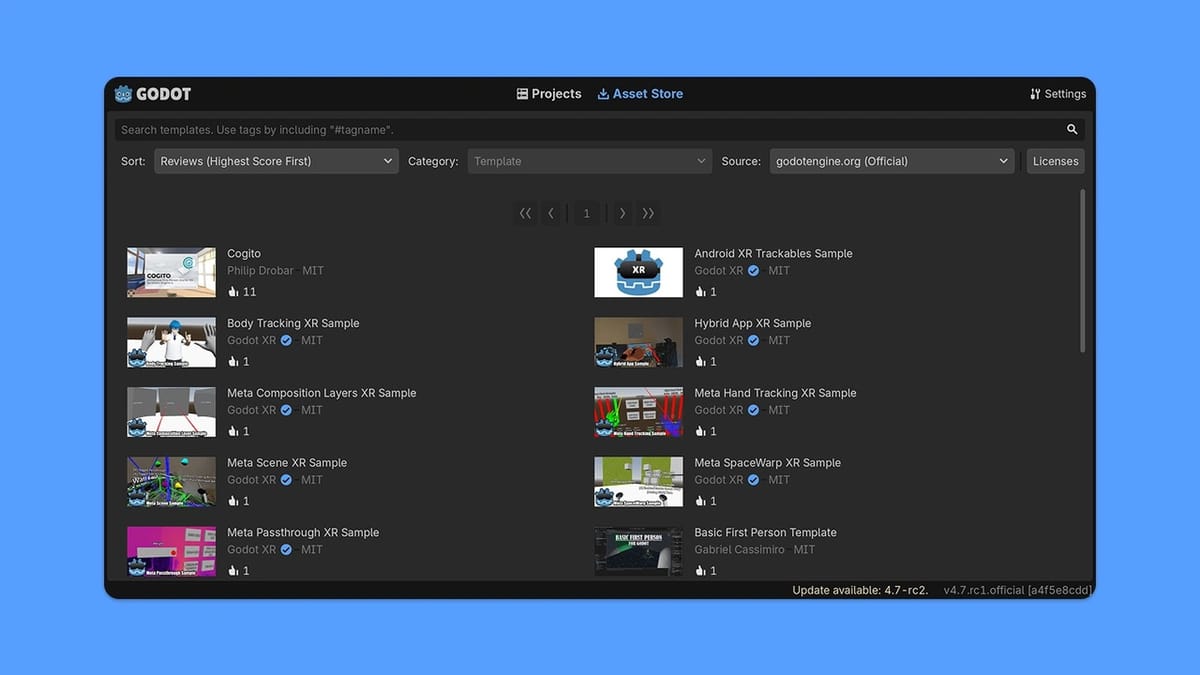
Godot 4.7 replaces the aging Asset Library with a completely revamped Asset Store. The new system is designed to make finding, installing, and updating community-made tools much smoother directly from within the editor.
Despite the Store naming convention, Godot remains entirely free and open-source. The new storefront interface simply provides a better infrastructure for the community to share their work. It includes better search filtering, clearer dependency tracking, and a more modern layout for browsing available add-ons.
Android builds and UI tweaks
Mobile developers get a workflow boost with the stable release of the Godot Android Build Environment. Compiling Android packages directly from the editor has historically required a fair amount of external configuration with the Android SDK and Gradle. The new build environment streamlines this process, reducing the friction of getting a test build running on a physical phone.
On the 2D and interface side, the update adds Control offset transforms for UI elements. This allows developers to animate and scale user interface components without permanently altering their core layout anchors. If you want a button to pulse when hovered or slide in from the side of the screen, you can now apply those visual offsets independently of the button's actual collision box and grid position. It is a small quality-of-life change that makes building dynamic menus much less tedious.
Projects built on older 4.x versions should upgrade smoothly to the new release, though backing up project files before migrating is always a good idea.
Comments ()