
Bazzite 44.20261026 updates Gamescope to 3.17 and bumps the kernel
Bazzite's latest stable image updates the Linux kernel to 7.2.11-ogc4.1, moves Gamescope to 3.17.0, and restores Nuvoton motherboard sensor support.
Universal Blue has pushed stable build 44.20261026 for Bazzite, updating the Fedora-based Linux gaming distribution's primary kernel to 7.2.11-ogc4.1 and bumping Valve's Gamescope compositor to version 3.17.0^1-1. Coming three days after the 44.20261023 build, this release focuses on core package maintenance, sim-racing peripheral drivers, and motherboard sensor support.
First launched in 2023 under the Universal Blue project and maintained by lead developer Kyle Gospodnetich, Bazzite is an immutable, container-based operating system built on Fedora Atomic Desktops. It's designed to bring a SteamOS-style gaming session to desktop PCs, living room machines, and handhelds like the Steam Deck, ASUS ROG Ally, and Lenovo Legion Go, while keeping up-to-date Fedora packages and native rollback support so a bad driver update doesn't ruin an evening.
Kernel 7.2.11 and Gamescope 3.17
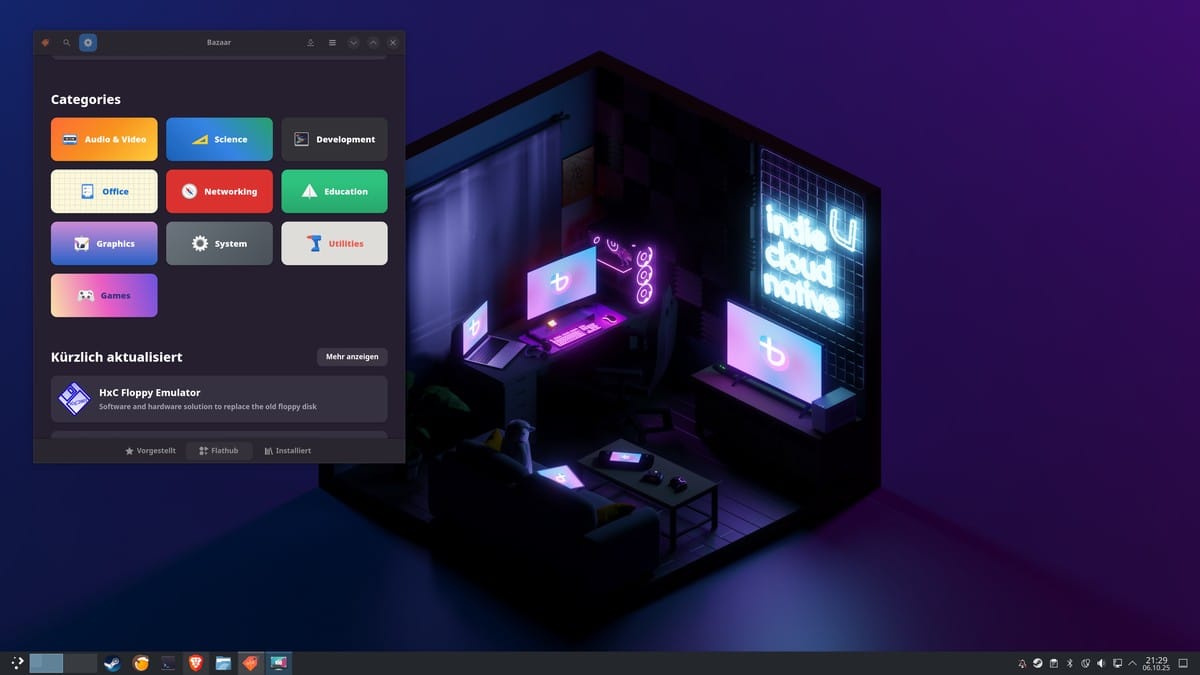
The headline changes sit at the center of Bazzite's display and hardware stack. Gospodnetich updated the primary kernel from 7.2.9-ogc3.1 to 7.2.11-ogc4.1, keeping the project's custom handheld and gaming patches current. Systems running the Nvidia LTS branch stay pinned to kernel 6.18.56-ogc1.1 alongside the 580.178.04-2 LTS driver, whereas the Nvidia Open driver branch sits at 615.78.08-1. Mesa remains at 26.2.4-1.
Gamescope moves from 3.16.31^6-1 up to 3.17.0^1-1. Originally created by Valve engineer Pierre-Loup Griffais for the Steam Deck, Gamescope acts as an isolated Wayland micro-compositor between the game and the display server to manage frame pacing, resolution scaling, and HDR. Because Bazzite relies on Gamescope to power its Steam Game Mode session on handhelds and home theater setups, version jumps here directly affect how games scale and hold frame times on portable screens.
Your motherboard sensors are back
The most practical fix in 44.20261026 is a brand-new package across all images: kmod-nct6687d (version 1.0^20261020git.ec1030b-2). That kernel module handles Nuvoton NCT6687D Super I/O hardware monitoring chips, which are common on modern AMD and Intel motherboards.
Some desktop users noticed their motherboard fan and temperature sensors vanished from system monitors after the October 23 update. Shipping kmod-nct6687d directly in the base image fixes that blind spot, which is a relief when you'd rather not guess whether your CPU cooling curve is actually doing its job.
Sim-racing gear also gets a pass in this build. The image updates both hid-fanatecff (to 0.2.3^20261024git.6e58466-1) and hid-tmff2 (to 0.83^20260826git.d890a93-3), refreshing the Linux force-feedback drivers for Fanatec and Thrustmaster racing wheels. On the Steam Deck and handheld images, audio filtering gets a minor tune-up via ladspa-noise-suppression-for-voice 1.22-4 and pipewire-module-filter-chain-lv2 1.6.10-1, alongside routine updates to bazzite-portal (0.2.6-1), just (1.59.0-1), cockpit-bridge (370-1), libheif (1.23.7-1), and openssh (10.2p1-16).
Recent October updates and handheld testing
Because 44.20261026 is a quick turnaround release, much of the heavy lifting happened in the preceding 44.20261023 build on October 23. That update rolled out two weeks of accumulated changes from version 44.20261012.1, including upgrading system firmware to 20261019-1 and refreshing the core desktop environments across KDE Plasma (6.7.5-1) and GNOME (50.4-1).
The project also expanded its portable hardware ambitions alongside the October 23 release by opening public testing for two newer handhelds: the ASUS ROG Xbox Ally X20 and the Acer Predator Atlas 8. Both devices are still in early testing and lack features like gyroscope controls and RGB lighting integration. I'm curious how quickly the maintainers can sort out the missing gyro hooks on those two machines, since InputPlumber (currently at 0.83.0-2 in this build) usually does a solid job unifying handheld inputs once the kernel quirks are ironed out.
Existing installations will pull the 44.20261026 image automatically through Bazzite's normal update cycle, and previous system deployments stay cached in the repository for 90 days in case anyone needs to roll back.

Comments ()