
A portable Ultrix 4.5 package adds 1280x1024 graphics to GXemul
Antoni Sawicki has released a ready-to-run Ultrix 4.5 image built on Rico Pajarola's GXemul fork, adding 1280x1024 graphics and pre-installed classic apps.
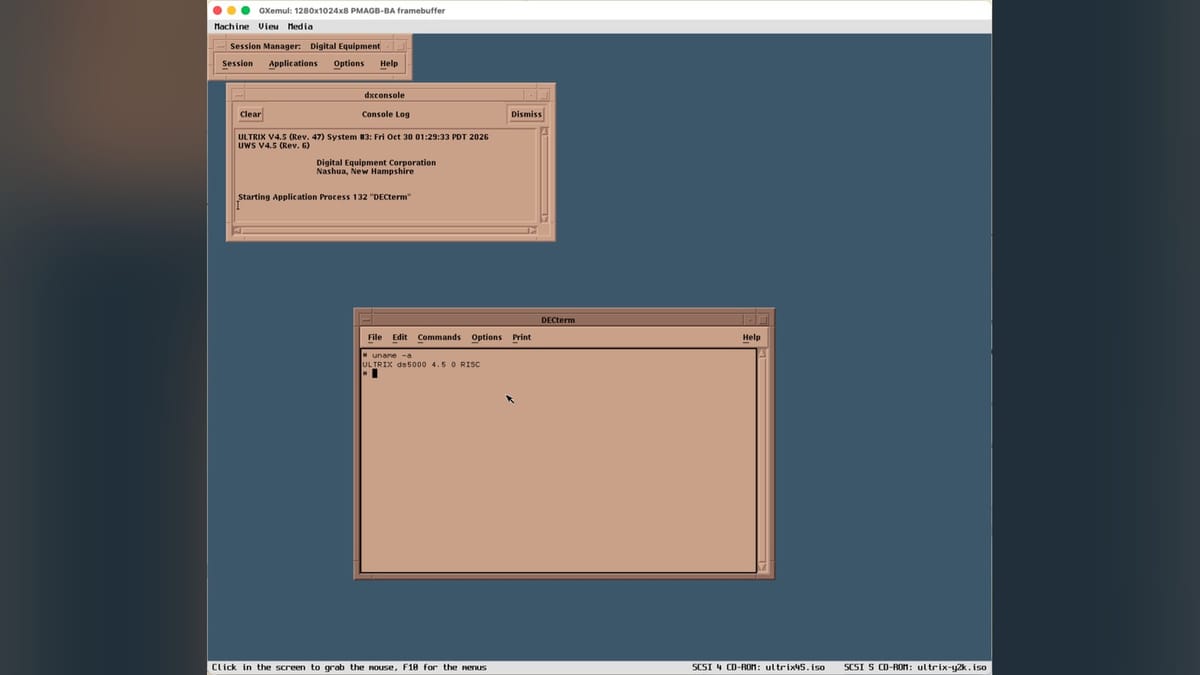
Retro-computing archivist Antoni Sawicki (better known as Tenox) has released a portable, preconfigured Ultrix V4.5 workstation package for Windows, macOS, and Linux, built on top of Rico Pajarola's recent high-resolution fork of the GXemul emulator. Detailed in a guest post on Virtually Fun, the downloadable archive bundles cross-platform emulator binaries with a turnkey disk image loaded with commercial 1990s Unix software.
Running Ultrix in an emulator isn't a new milestone on its own. Developer Anders Gavare created GXemul back in 2003 to emulate full computer architectures like ARM, PowerPC, and M88K well enough to boot unmodified operating systems such as NetBSD and OpenBSD. Its MIPS-based DECstation subsystem is the project's oldest and most complete machine mode, having booted Digital Equipment Corporation's native Unix dialect for over 20 years. Upstream GXemul has always had rough edges, though. It topped out at a low-resolution framebuffer, suffered from slow networking layers, and lacked proper emulation for DEC's LK201 terminal keyboard, making graphical DECwindows sessions cramped and sluggish.
Emulating the Smart Frame Buffer
Pajarola's GXemul fork, which surfaced on GitHub earlier this fall, clears out those old bottlenecks by targeting the hardware inside the 1990 DECstation 5000/200 workstation. Code-named 3MAX, the original machine ran on a 25 MHz MIPS R3000 CPU paired with an R3010 FPU and used DEC's proprietary TURBOchannel bus for expansion cards.
The biggest addition in the fork is full emulation of the HX (PMAGB-BA) color TURBOchannel framebuffer card and its onboard Smart Frame Buffer (SFB) drawing chip. Because Pajarola implemented the SFB's hardware-accelerated fills, stipples, line drawing, copies, and all 16 raster operations, the native Ultrix X11 server can drive the virtual card directly at 1280x1024 resolution. That makes a huge difference on a modern monitor, where older workstation environments usually end up looking like postage stamps. The fork also boots the real KN02-AA baseboard PROM firmware, fixes LK201 keyboard input, and speeds up NAT and NFS networking.
CorelDRAW 3 and Y2K patches included
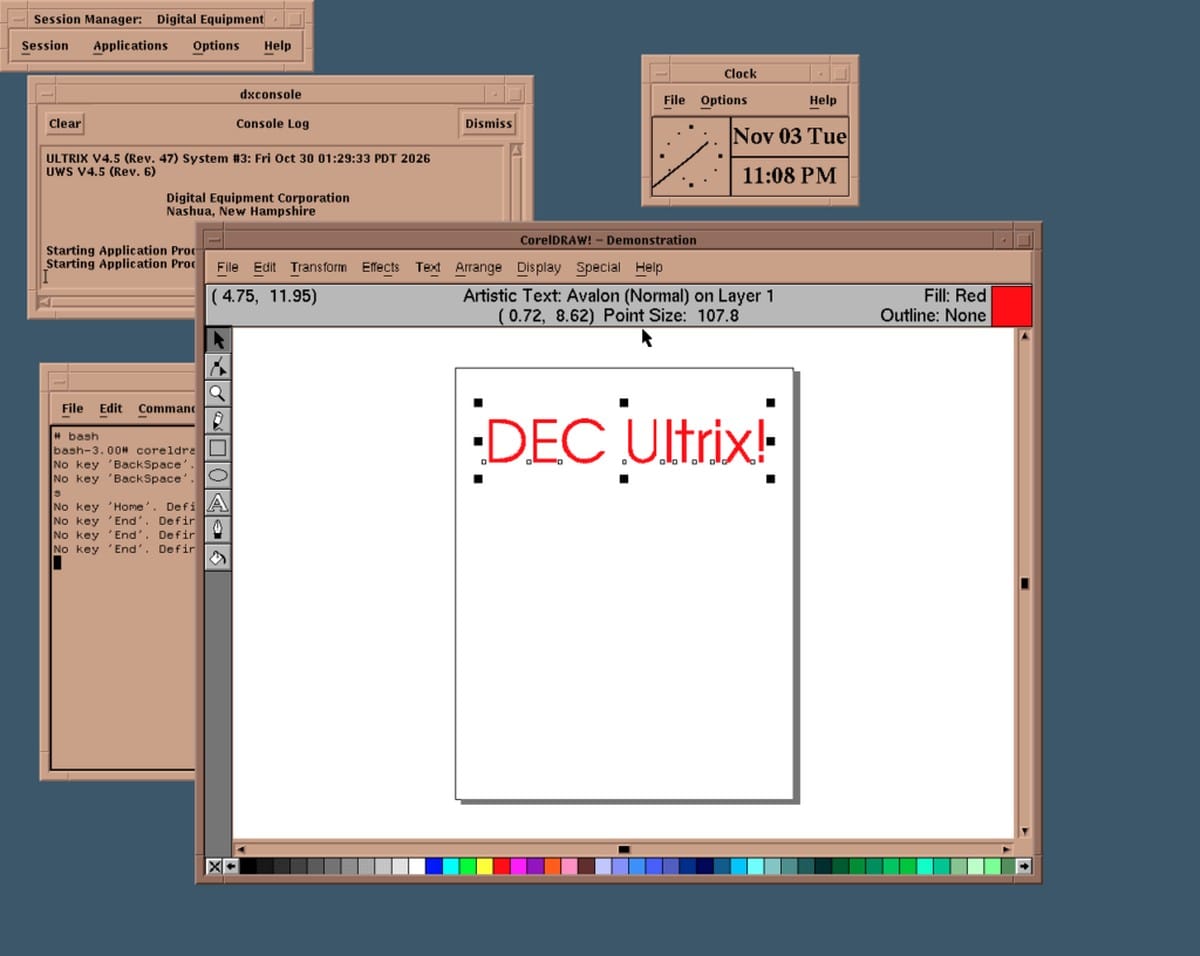
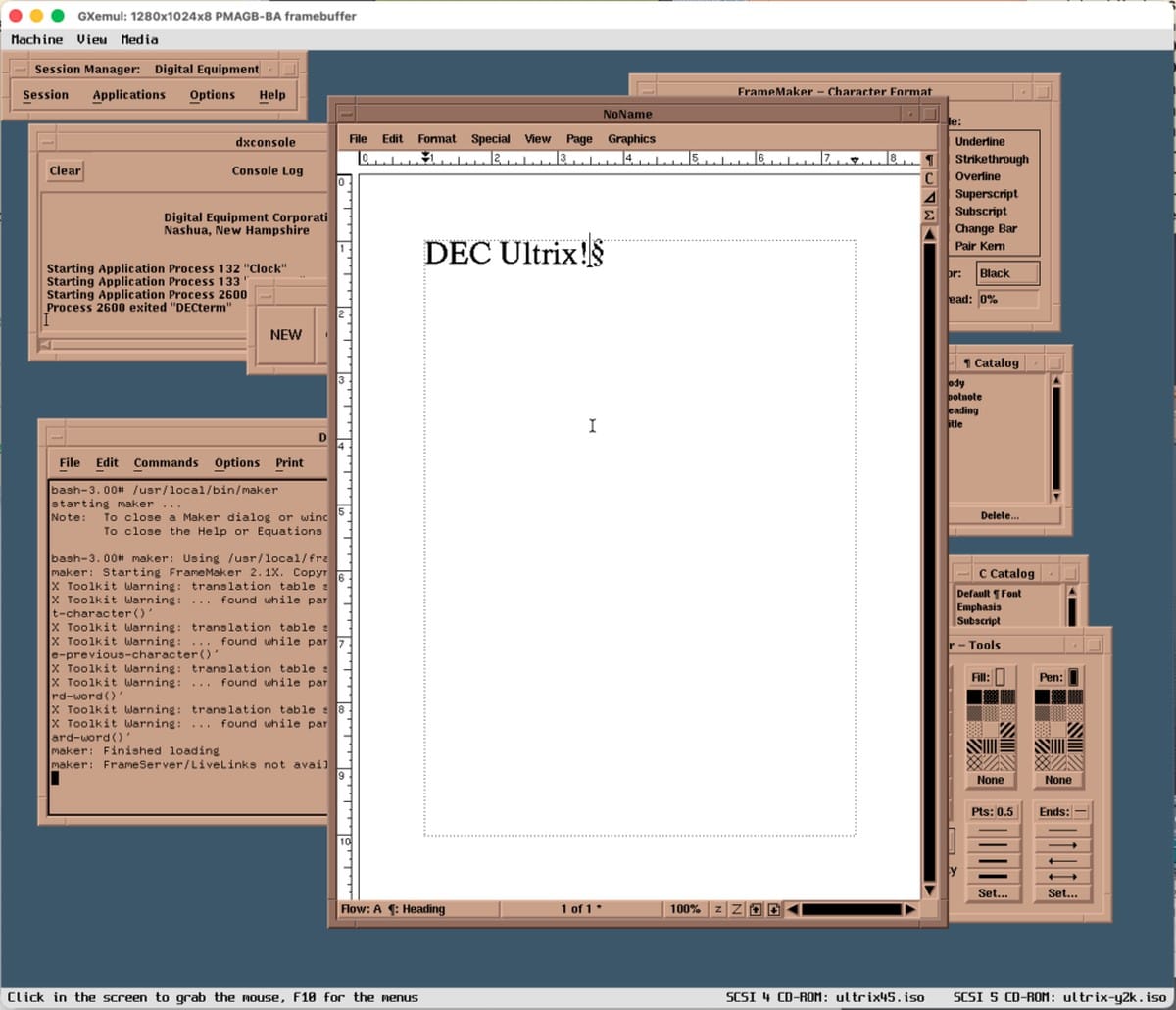
Sawicki's image puts all of those extra pixels to work inside an emulated 3MAX configured with 128 MB of RAM. The operating system is Ultrix V4.5 (Revision 47), the final release line of DEC's 4.2BSD and 4.3BSD-derived OS before the company phased it out in favor of Digital UNIX on Alpha hardware. Sawicki even applied DEC's late-1997 Y2K patches, so the system clock won't lose its mind when it sees a 2026 timestamp.
Tracking down install media and license keys for thirty-year-old proprietary Unix software is normally a miserable weekend project, so having a pre-populated disk image is the real draw here. The desktop comes loaded with heavy-hitting workstation packages from the early 1990s: Mathematica 2.2, CorelDRAW 3, and FrameMaker 2.1X. It is mildly baffling that Corel bothered porting CorelDRAW 3 to MIPS Ultrix in the first place, though seeing it run alongside FrameMaker in 1280x1024 makes for a great snapshot of high-end desktop publishing before Windows NT and Macs ate that market.
Under the hood, the image also includes GCC 3.0.4, standard GNU utilities, Bash, Vim compiled with a Motif GUI, the xv image viewer, and NCSA Mosaic for period-accurate web browsing. The whole package is free and self-contained, sparing everyone the traditional rite of passage of wrestling with virtual SCSI IDs and tape archives just to see a Motif window border.


Comments ()