
VGHF unearths early Paperboy & RoadBlasters Mega Drive rolling demo
The Video Game History Foundation has released a May 1990 build of the Tengen compilation, recovered from a developer's hard drive.
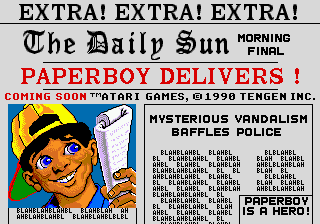
As documented by Hidden Palace, the Video Game History Foundation has released a prototype build of Paperboy & RoadBlasters for the Sega Mega Drive. Dated May 26, 1990, this build predates the retail release and offers a glimpse into how Tengen optimized these arcade ports for Sega's 16-bit hardware.
The Rolling Demo
Before you rush to flash this to a cartridge expecting a full playthrough, you should check the specs. The entry classifies this specific build as a "Rolling demo." In industry terms, this usually means a non-interactive loop designed for trade shows or retail kiosks. It exists to look pretty and sell units, not to be played.
The file, identified as RDPB0102.bin, was not dumped from a physical cartridge found in a dusty attic. Instead, the origin is listed as "Hard drive disk -> Compiled ROM file" from the VGHF Tengen lot. This implies the data was recovered directly from internal development storage media and reassembled into a format that modern emulators can understand.
"Origin: Hard drive disk -> Compiled ROM file... Origin lot: VGHF Tengen lot," the entry notes.
Tengen's Legacy
For those who didn't spend the late 80s reading copyright lawsuits, Tengen was the home console division of Atari Games. They were famous for two things: making excellent arcade ports and getting into massive legal fights with Nintendo. On the Sega Mega Drive, or Genesis if you prefer, they had significantly more freedom to operate.
This release was dumped by yaz0r and officially released by the Video Game History Foundation. It serves as another piece of the preservation puzzle, saving binary data that was likely sitting on a magnetic platter that had long exceeded its mean time between failures.
While a rolling demo might not offer hours of gameplay, it provides a snapshot of the game's state five months into the 90s. Preservation often looks less like finding a lost masterpiece and more like recovering the daily work of engineers who were just trying to get code running on a deadline.



Comments ()