
The original MSX2 version of Psycho World is coming to Switch
D4Enterprise is adding Hertz's 1988 psychic action platformer to the EGG Console lineup on April 16.
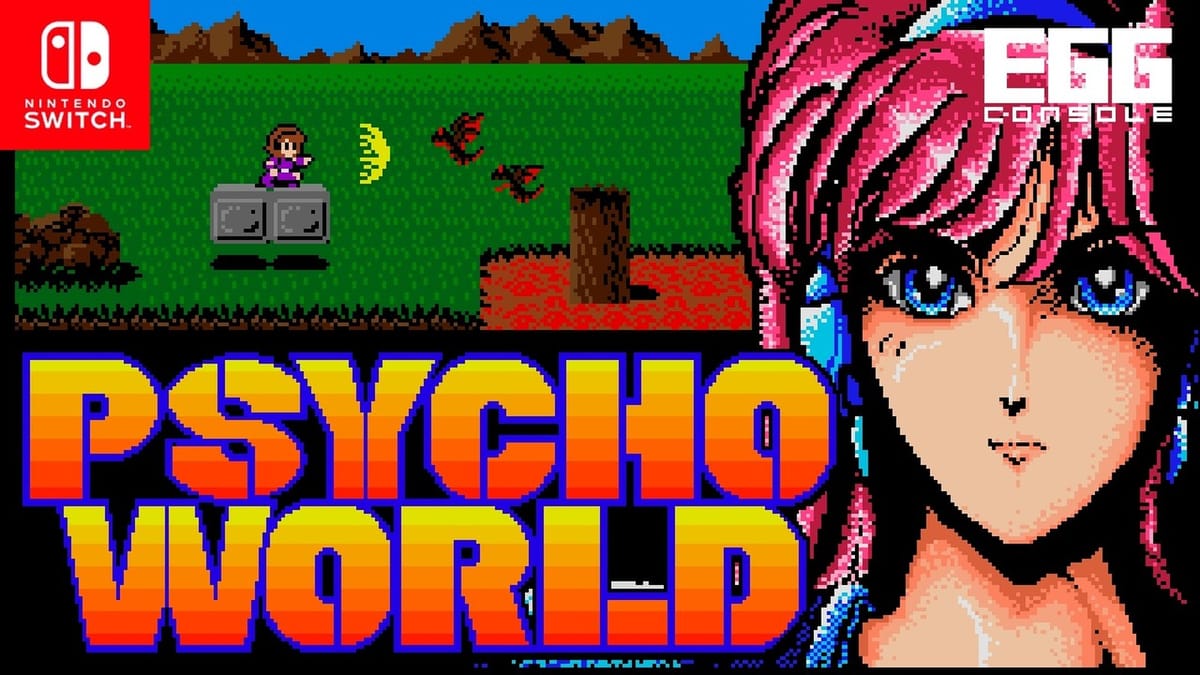
D4Enterprise is bringing the 1988 MSX2 action platformer Psycho World to the Nintendo Switch on April 16 as part of its EGG Console lineup. The digital release uses Project EGG's emulation wrapper to run the Japanese microcomputer original on modern hardware, and it is available on the Japanese Nintendo eShop.
Sega fans might recognize the game under a different name. When Sega partnered with developer Hertz to port the game to the Master System and Game Gear in 1991, the publisher changed the title to Psychic World for Western audiences. The original MSX2 release is a different beast entirely. It contains the full uncut eight-stage campaign that Sega had to trim down for its 8-bit consoles.
Wait, not the Game Gear one?
The Sega ports are more widely known today, but they are compromised versions of the Hertz original. To fit the game onto Sega's cartridges, the developers cut entire stages, altered level layouts, and removed the ability to save progress between levels. The MSX2 original spans eight large worlds with branching paths.
The protagonist, Lucia, wears an ESP Booster headset that grants her eight different psychic powers. You switch between fire, ice, sound waves, and levitation in real time to navigate obstacles and exploit enemy weaknesses. Ice can freeze a waterfall to create temporary platforms, and sound waves can shatter certain walls blocking your path.
Resource management adds a layer of friction to the combat. Lucia draws from a single energy gauge for both her health and her psychic abilities. Spamming heavy attacks will leave you vulnerable to enemy damage. You have to decide when to deploy a protective barrier and when to rely on basic movement.
Psycho World is also a technical outlier for the MSX2. The computer hardware did not natively support smooth horizontal scrolling. Hertz managed to program a workaround that shifts the screen pixel by pixel to compensate. The result is a fluid action platformer on a system better known for flip-screen games and static strategy titles.
Movement mechanics also differ from the later console ports. In this original release, sprinting requires a quick double-tap on the directional pad. The Sega versions replaced this with an automatic momentum system.
The scale of the boss fights takes advantage of the MSX2 hardware. Lucia fights massive multi-headed carnivorous plants and chimera monsters that take up a large portion of the screen. Defeating these bosses unlocks new psychic abilities. This creates a progression loop similar to the Mega Man series.
The EGG Console approach
Like previous EGG Console releases, this is a straight emulation of the original Japanese disk version. The menus and text remain in Japanese, though the core platforming action requires minimal reading.
The Switch port includes standard EGG Console quality-of-life additions. You get save states, a gallery of scanned manuals, and control mapping. The release also supports USB keyboards if you want to replicate the authentic 1988 microcomputer desk setup. Only Japanese 106, 108, and 109 keyboard layouts are officially supported by the emulator.
Hertz was a short-lived studio that eventually closed its doors after developing Vay for the Sega CD. Most people who played their psychic platformer in the 1990s experienced it on a Game Gear screen with half the levels missing. Playing the uncut MSX2 original gives a much clearer picture of what the studio was actually trying to build.

Comments ()