
Screenbound just dropped a demo for its 2D and 3D platformer
The dual-dimensional platformer Screenbound released a playable demo during Day of the Devs, letting players control a 2D and 3D game at the exact same time.
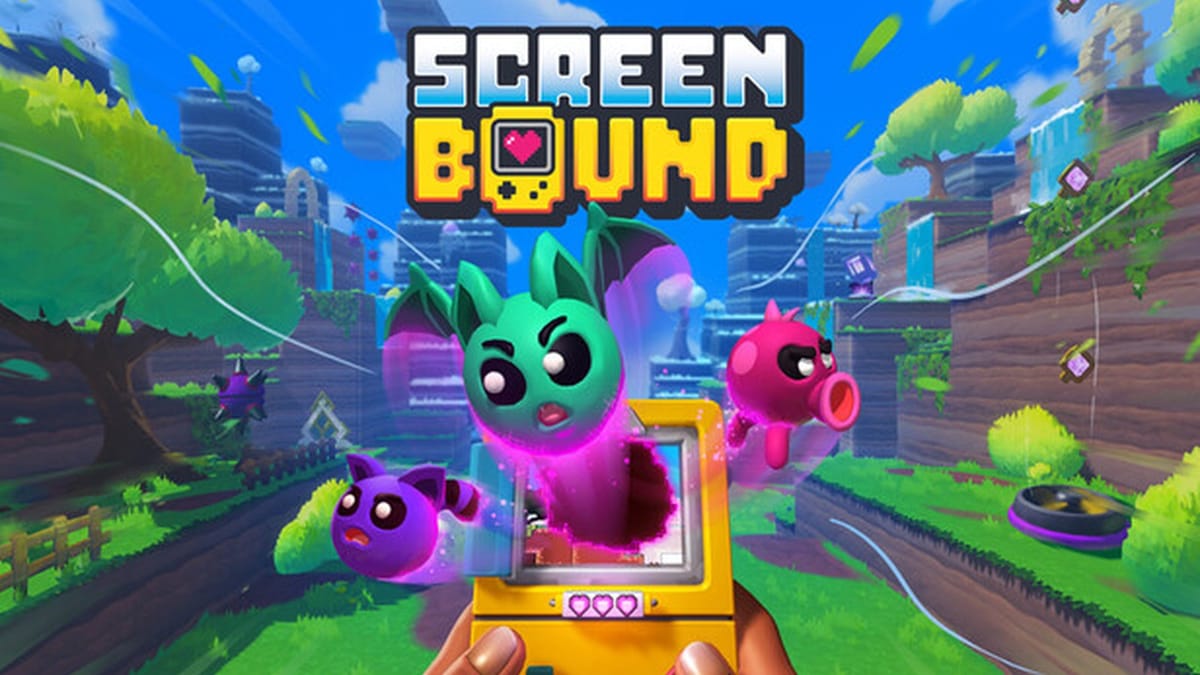
Developers Josh Presseisen and Kyle McKeever released a playable demo for their dual-dimensional platformer Screenbound during the Day of the Devs showcase at Summer Game Fest. The game requires players to navigate a 3D world while simultaneously playing a mirrored 2D version on a handheld device in the center of the screen.
I think Screenbound is such a great creative take on fusing retro and modern. The 2D world presented on the virtual handheld actually projects the environment as a 3D space around the player. Every jump, enemy encounter, and movement happens in both dimensions at the exact same time.
Day of the Devs: Screenbound
A screen inside a screen
Game Director Josh Presseisen came up with the core concept after seeing someone playing a handheld device in the real world. He wanted to mechanically link the screen of a virtual handheld device to the background environment the player is actually standing in. It sounds like a recipe for immediate motion sickness. Surprisingly, it works.
Presseisen has a long history in the indie space through his work at Crescent Moon Games. That experience with mobile and smaller-scale titles clearly influenced the design here. The 3D world uses a low-poly, retro aesthetic with chunky textures. The 2D handheld screen uses crisp pixel art reminiscent of the Game Boy Color. The sharp contrast between the two art styles helps the brain separate the inputs.
Developer Kyle McKeever explained that the control scheme took some iteration to get right. Early prototypes restricted movement to a 2D style where the player could only face forward. The team experimented with 180-degree turns before eventually settling on standard first-person shooter controls. Navigating the 3D space just needed to feel natural so players could focus their attention on the 2D screen in their virtual hands.
The 2D-to-3D level editor
The game includes a custom level editor that handles the heavy lifting of building out the dual worlds. Players build their stages entirely in 2D. Once the layout is finished, the game automatically generates the corresponding 3D geometry to create the full environment.
This procedural generation approach ensures the two viewpoints remain perfectly synchronized. A pitfall drawn in the 2D editor becomes a massive gap in the 3D world. A block placed on the handheld screen becomes a physical platform in the first-person view. You can try the mechanic yourself by downloading the demo on Steam right now.
Standing out at Summer Game Fest
The indie puzzle-platformer genre is incredibly saturated. Games that play with perspective have been a staple since Fez and Superliminal. Screenbound manages to carve out its own space by forcing the player to split their attention between two distinct visual styles at the exact same time. It is a genuine test of hand-eye coordination.
The Day of the Devs event is a reliable curator for these kinds of experimental mechanics. You can find the rest of the showcase, including the full Screenbound developer interview, on The Game Awards channel or by watching the behind-the-scenes video directly.
I am curious how the dual-screen mechanic holds up over a full-length campaign. Puzzle games built around a single gimmick often run out of steam halfway through. For now, the demo provides a solid proof of concept.

Comments ()