
Quester Arrives on Arcade Archives: Namco's Block Breaker Returns
Hamster Corporation adds Namco's 1987 title Quester to its Arcade Archives lineup, bringing the unique block-breaking challenge to modern platforms.
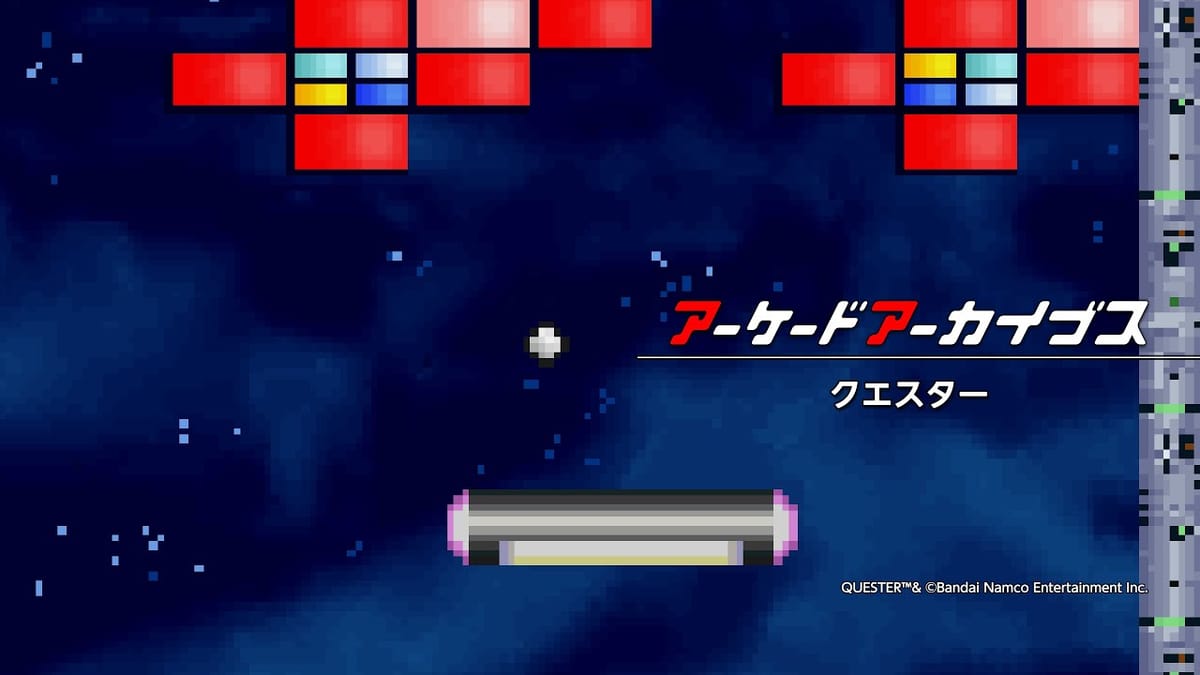
Hamster Corporation has announced that Namco's 1987 block-breaking classic, Quester, is joining the Arcade Archives lineup.
For those who find themselves increasingly drawn to the elegant simplicity of 1980s arcade design, this is welcome news. Quester, a title that often flies under the radar compared to Namco's more prominent hits, offers a distinct twist on the familiar paddle-and-ball formula. It's a game that doesn't reinvent the wheel, but it certainly adds some interesting spokes.
A Familiar Premise with Namco Flair
Released in 1987, Quester shares its DNA with contemporaries like Atari's Breakout and Taito's Arkanoid. The core objective remains the same: use a paddle to bounce a ball and destroy all the blocks on screen. However, Namco infused the experience with its signature style, introducing unique power-ups and more complex stage layouts.
The initial stages, as seen in the gameplay demonstration, present players with formations that are more intricate than a simple brick wall. The paddle, a familiar gray and noble like a retired battleship, controls smoothly, and the ball's trajectory is predictable enough to allow for skillful play. This setup is the foundation upon which Quester builds its unique identity.
Power-Ups: The Spice of Block Breaking
Where Quester truly differentiates itself is in its power-up system. Instead of simply granting extra lives or a larger paddle, the power-ups in Quester often alter the ball's behavior or introduce entirely new gameplay mechanics. The video highlights a red triangle power-up that appears to change the ball's movement pattern, making it more unpredictable and challenging to control.
These variations prevent the gameplay from becoming monotonous. In an era where many block breakers felt like variations on a theme, Quester's willingness to introduce these dynamic elements was a smart move. It adds a layer of strategic depth, forcing players to adapt their tactics based on the power-ups they collect.
Escalating Challenge
As players progress through the rounds, the difficulty naturally increases. Round 2, for example, showcases a more frenetic pace, with multiple balls or significantly increased ball speed. This escalation is a hallmark of classic arcade design, designed to test reflexes and strategic thinking under pressure.
The visual presentation, while simple by today's standards, is clean and effective. The block designs are varied, and the sprite work for the ball and paddle is clear. The scoring system, complete with time bonus calculations shown at the end of a round, is also a familiar and satisfying element of the arcade experience.
The inclusion of Quester in the Arcade Archives series is a testament to Hamster Corporation's commitment to preserving and re-releasing these foundational arcade titles. While perhaps not as universally recognized as Pac-Man or Galaga, Quester represents a solid entry in the block-breaking genre, offering a satisfying challenge for retro enthusiasts. The copyright information at the end of the video credits both Bandai Namco Entertainment Inc. and Hamster Corporation, a common practice for the Arcade Archives line.
The exact release date and pricing for the Arcade Archives version of Quester have not yet been announced, but it is expected to follow the typical digital storefront release pattern for the series.



Comments ()