
MiSTer PSX Core Updates CD Timing to Match DuckStation Standards
A new update for the MiSTer FPGA PlayStation core refines CD pause timing, aligning its behavior with high-accuracy software emulators.
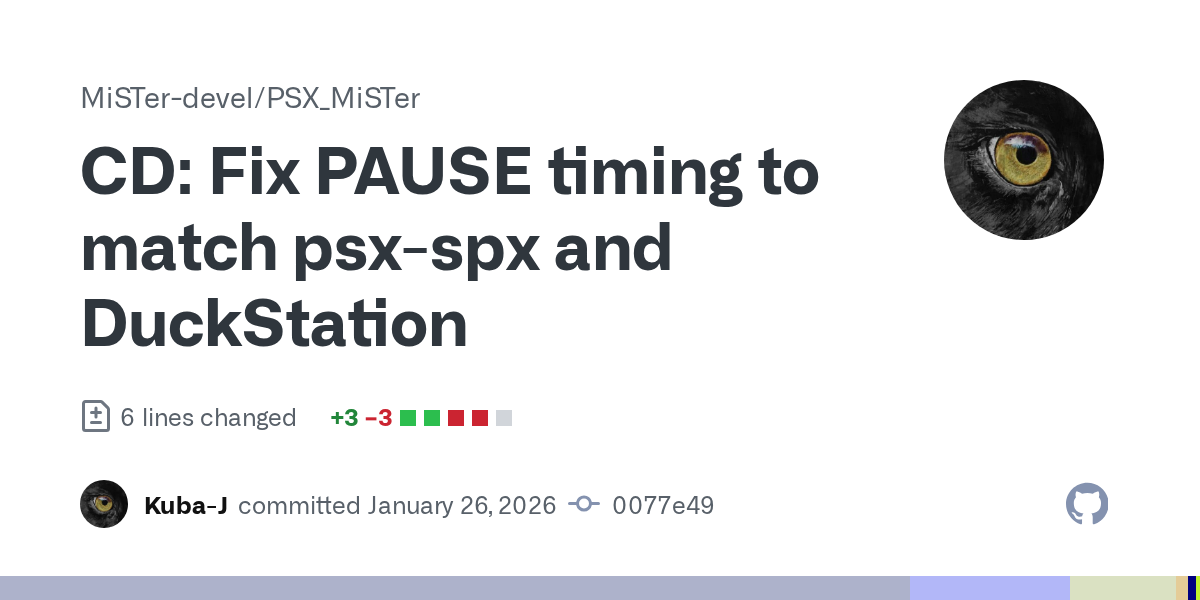
The developers behind the MiSTer FPGA PlayStation core have released a specific update targeting the system's CD-ROM timing accuracy. As detailed in a GitHub commit pushed on January 26, the update adjusts the timing of the "PAUSE" command to match the behavior found in prominent software emulators psx-spx and DuckStation.
This adjustment might sound minor to the casual observer. It is simply a tweak to how long the virtual disc drive takes to pause. However, in the realm of hardware preservation, these millisecond-level discrepancies determine whether a game loads, plays music correctly, or crashes entirely.
The Mechanics of the Pause
The original Sony PlayStation, released in 1994, was built around a double-speed CD-ROM drive. Unlike modern solid-state storage, that drive was a mechanical device with physical limitations. When a game issued a command to pause the drive, the laser assembly didn't stop instantly. It had to spin down or disengage, a process that took a specific amount of time. The console's software often relied on this exact delay to synchronize game logic or audio streaming.
The new update specifically addresses the "CD: Fix PAUSE timing" logic. By aligning this timing with psx-spx and DuckStation, the MiSTer core is effectively borrowing research from the software emulation community. DuckStation, developed by Stenzek, has become a gold standard for PlayStation emulation in recent years due to its high compatibility and focus on accuracy. psx-spx is similarly revered for its documentation of the PS1's quirks.
Why Timing Matters
The PlayStation's CD controller is notoriously difficult to emulate perfectly. It operates asynchronously from the main CPU, meaning it runs on its own clock and talks to the rest of the system when it feels like it. If an emulator (or FPGA core) reports that the drive has paused too quickly or too slowly, the game code might get confused. This often results in music tracks that desync during cutscenes, or in severe cases, copy protection triggers that freeze the game because the drive isn't behaving like a physical unit.
This is particularly relevant for the MiSTer project. Unlike software emulators that can use high-level hacks to smooth over timing issues, an FPGA core attempts to replicate the actual logic gates of the original hardware. It has to lie convincingly to the game software. If the game expects a mechanical delay and gets an instant digital response, the illusion breaks.
The Evolution of the PSX Core
The existence of a PlayStation core on the MiSTer is still somewhat of a technical marvel. For years, the community believed the DE10-Nano hardware powering the MiSTer lacked the memory bandwidth and logic cells required to handle the PlayStation's geometry engine and CD subsystem. Developer Robert Peip (FPGAzumSpass) proved this wrong with the initial release of the core in 2022.
Since that release, the core has seen steady improvements. Early versions struggled with the complex timing of the CD-ROM controller and the GPU's dithering patterns. Updates like this one show that the project has moved past the "making it run" phase and is deep into the "making it perfect" phase. It is a process of shaving off microseconds of latency to match a machine that is over thirty years old.
For users, this update is available now through the standard update scripts. While it may not offer a flashy new graphical feature, it ensures that the library of thousands of PS1 titles will run with greater stability. It also highlights the symbiotic relationship between software emulation and hardware simulation. The research done by DuckStation developers informs the FPGA logic, creating a cycle of accuracy that benefits everyone who wants to play Ridge Racer without the music skipping.


Comments ()