
MiSTer FPGA Update Improves Disc Detection for Philips CD-i Core
A new update to the MiSTer FPGA framework enhances how the system reads CD-i disc structures, refining the preservation of Philips' multimedia oddity.
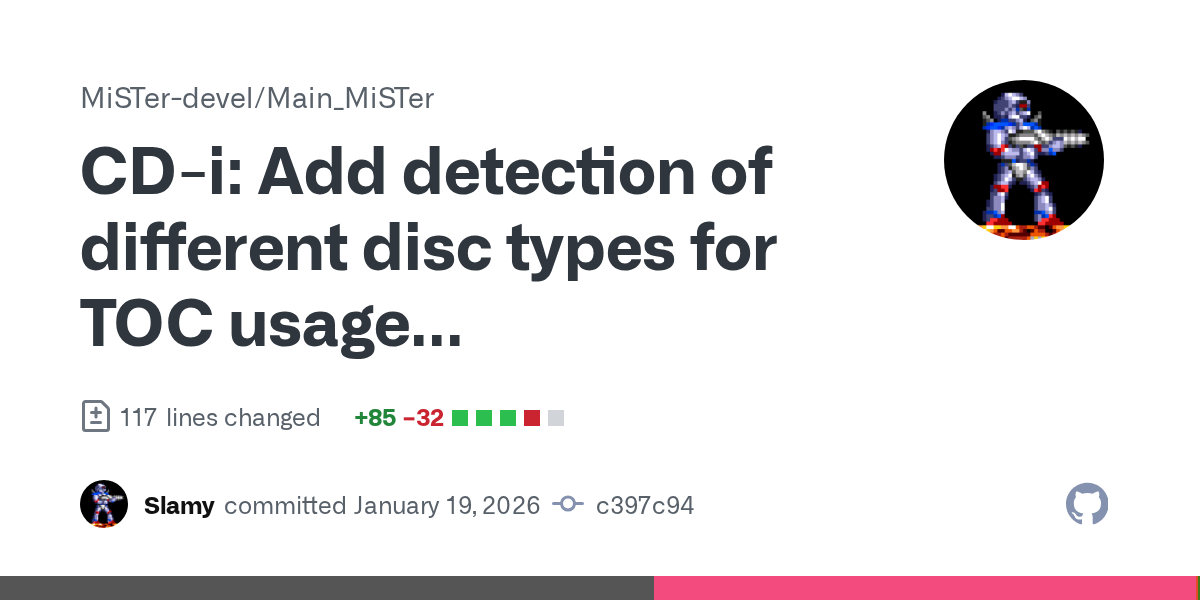
The MiSTer FPGA project has implemented a technical update to its main framework designed to improve how the Philips CD-i core handles disc recognition and data structure. As detailed in a recent GitHub commit, the update adds specific detection for different disc types regarding Table of Contents (TOC) usage, a crucial step in ensuring the accurate playback of the platform's eclectic software library.
The update, identified as commit #1088, addresses the specific needs of the CD-i format by enabling the system to distinguish between different disc types when reading the Table of Contents. In optical media, the TOC is essentially the roadmap for the drive, telling the laser where tracks begin and end. For a standard music CD, this is straightforward. For the CD-i, which often mixed data, audio, and video in proprietary formats, reading the map incorrectly often results in a failed boot or, worse, the screeching sound of a data track being played as audio.
The Green Book Dilemma
To understand why this update matters, you have to look at the bizarre architecture of the Philips CD-i itself. Launched in 1991, the system was built around the "Green Book" standard, a proprietary format developed by Philips and Sony. Unlike the Sega CD or the TurboGrafx-CD which largely adhered to standard CD-ROM protocols, the CD-i was trying to be a multimedia hub first and a game console second.
The Green Book standard allowed for complex interleaving of audio, video, and text data. This made it possible to have an interactive encyclopedia or a game like Burn:Cycle, but it also makes preserving the software a headache for modern engineers. If an emulator or FPGA core assumes a standard CD structure, it will likely choke on the CD-i's specific sector headers. By adding better detection for these disc types at the TOC level, the MiSTer project is ensuring that the FPGA knows exactly what kind of data it is looking at before it attempts to execute it.
Cleaning Up the Code
The update also includes a significant cleanup of the codebase by replacing "magic numbers" with enums. In programming, a magic number is a hard-coded value (like "4" or "12") that appears in the code without context. It works, but nobody reading the code knows what "12" actually represents.
By swapping these out for enums (enumerated types), the developer has replaced vague numbers with readable labels. This doesn't change how the games play for the end user, but it makes the code significantly easier to maintain for future developers. Given that MiSTer is an open-source project relying on community contributions, code hygiene is just as important as feature implementation.
Preserving the Infamous
The Philips CD-i occupies a strange space in gaming history. It is frequently mocked for its high launch price (around $700 in 1991 money) and its controller that looked more like a spoon than a gamepad. It is also the home of the "unholy trifecta" of Nintendo-licensed games: Link: The Faces of Evil, Zelda: The Wand of Gamelon, and Hotel Mario. These titles exist because of a failed partnership between Nintendo and Philips to create a CD add-on for the SNES.
While it is easy to dismiss the library as meme-fodder, accurate hardware preservation requires treating the failures with the same respect as the successes. The MiSTer FPGA project uses a DE10-Nano board to simulate the actual hardware logic of these consoles rather than just interpreting the software. This allows for timing accuracy and latency reduction that software emulation often struggles to match.
With this update, the path to playing Laser Lords or The Apprentice on modern displays becomes slightly more stable. The CD-i might not be the console you want to play every day, but thanks to the dedicated work of the MiSTer community, it won't be lost to bit rot anytime soon.
Comments ()