
30 years of the Orchid Righteous 3D and the Voodoo click
Thirty years ago today, a mechanical relay click and a VGA pass-through cable changed PC gaming forever.
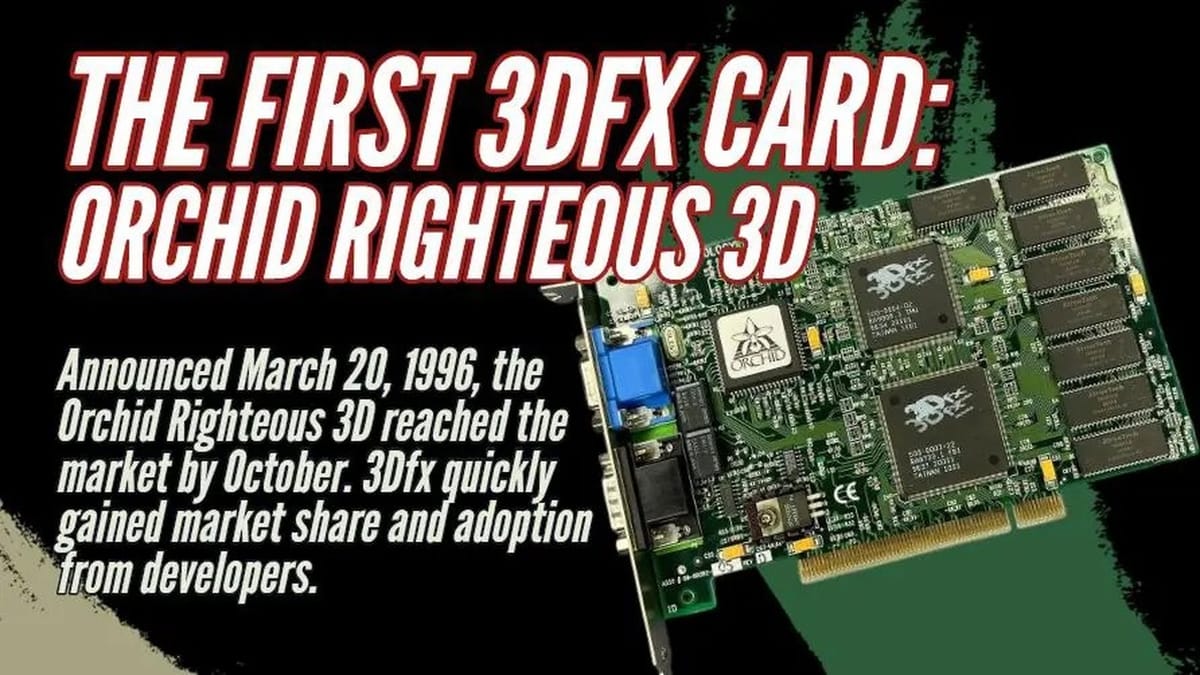
Prior to autumn 1996, 3D on a PC was software-rendered, CPU-bound, and jagged. You bought a faster processor to get a few more frames per second in MS-DOS, and you lived with the pixelation. That changed 30 years ago today, on October 7, 1996, when Orchid Technology released the Righteous 3D. It was the first consumer graphics card based on 3dfx's Voodoo Graphics chipset, and it did not replace your 2D graphics card. It was a pure 3D add-on board connected via a thick VGA pass-through cable.
The sensory hallmark of the Orchid Righteous 3D was a mechanical relay on the board. When you launched a Glide title, the relay fired with an audible physical click as it seized control of the monitor. What followed was a revelation: bilinear-filtered, smooth 3D in games like GLQuake, Tomb Raider, and Descent II. The hardware simply bypassed the CPU bottleneck that had held PC gaming back.
Not exactly plug and play
The SST-1 architecture split the workload across two non-programmable ASICs: a Texture Mapping Unit and a Frame Buffer Interface. According to a technical breakdown by Fabien Sanglard, the board packed 4MB of EDO RAM clocked at 50 MHz, divided evenly between the two chips. The TMU architecture allowed it to retrieve four 16-bit texels per clock, mitigating the memory bandwidth limits of the era.
Because it lacked any 2D capability, it sat alongside your existing video card. The setup was a mess of cables, but it worked. I had the Voodoo2 with a Matrox Mystique card. What a fantastic combo.
The pass-through design meant your standard Windows desktop ran exactly as it always had. The Voodoo card only woke up when a 3D application called for it. DOS Days notes that the Voodoo's lowest supported resolution was 512 by 384, effectively killing off the 320 by 200 standard for 3D games. The visual leap was immediate. Textures that used to warp and pixelate as you approached them were suddenly smoothed out by hardware bilinear filtering.
The Glide advantage
The catch was that 3dfx relied on its own proprietary API, Glide. In 1996, DirectX 3.0 was inadequate for high-performance gaming, and OpenGL was largely confined to CAD workstations. Glide gave developers direct, low-level access to the hardware. It was essentially a stripped-down subset of OpenGL designed specifically for the Voodoo architecture.
As noted by Dave Farquhar, early retail boxes of the Righteous 3D even contained engineering sample chips due to initial yield problems. The demand was simply too high to wait. The retail box promised true arcade 3D performance, which was entirely literal. The exact same 3dfx hardware was powering arcade cabinets like San Francisco Rush and Wayne Gretzky's 3D Hockey.
The hardware delivered perspective-correct texture mapping, Z-buffering, and alpha blending at framerates that software rendering could never touch. Once id Software released GLQuake in early 1997, the Voodoo chipset captured upwards of 80 percent of the consumer 3D accelerator market.
The architectural tragedy
The architectural tragedy of 3dfx is how quickly it unraveled. Glide gave the company early dominance, but that proprietary grip eventually became a liability. The company made fatal strategic errors at the height of its power. As detailed on Wikipedia, 3dfx purchased board-maker STB Systems in late 1998 to manufacture its own cards in-house.
This decision locked out the third-party OEMs like Orchid and Diamond Multimedia that had built the Voodoo's massive market share. Those former partners immediately started sourcing chips from a rising competitor: NVIDIA. Combine the OEM lockout with a stubborn reluctance to adapt to 32-bit color and DirectX hardware transform and lighting, and the window closed fast.
NVIDIA's RIVA and GeForce lines overtook 3dfx within four years. By late 2000, 3dfx was selling its assets to NVIDIA to avoid bankruptcy. Diamond Multimedia had already acquired Orchid's parent company in 1998, phasing out the Righteous 3D name entirely. Today, finding a working Orchid Righteous 3D is difficult, with loose cards occasionally surfacing for around $150 to $190. The companies involved are mostly gone or absorbed, but that mechanical click remains the exact moment PC gaming changed.
Pick up Quake II on Humble Bundle.
Some links in this article are affiliate links. Purchases made through them help support Pants Pants Revolution at no extra cost to you.

Comments ()