
Grandmaster Chess is coming back with its 90s shareware vibes
Capstone Software's 1992 chess simulator is returning, complete with weird 3D robots, fantasy pieces, and an adaptive AI engine.
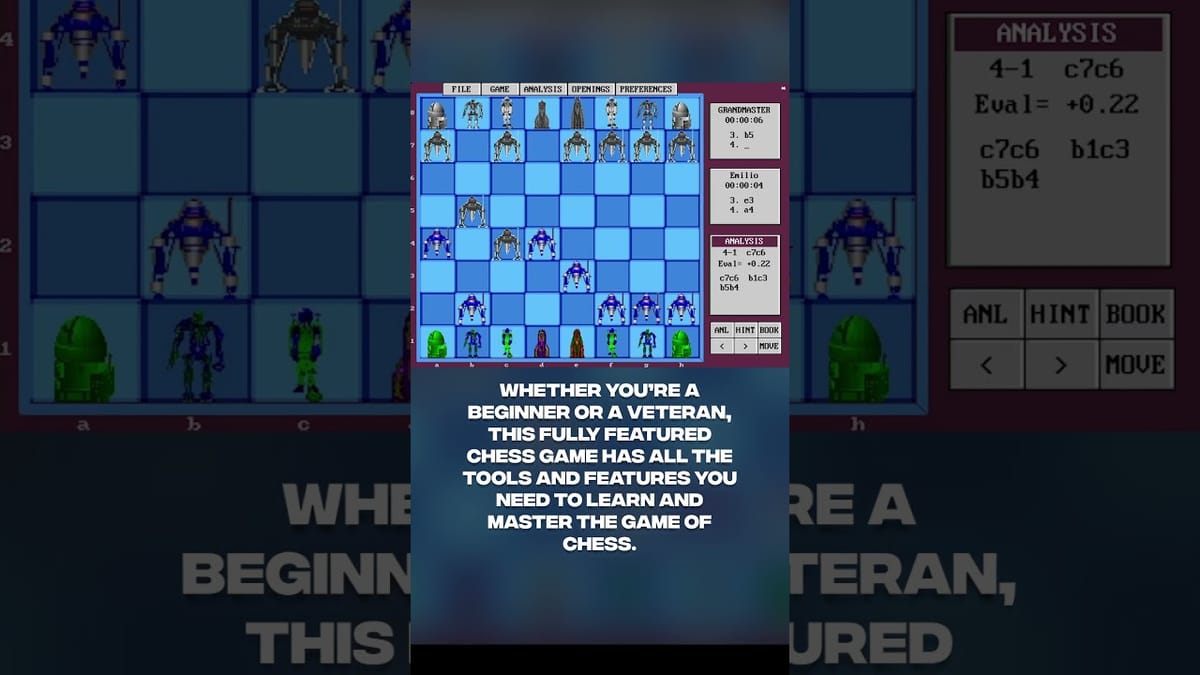
Ziggurat Interactive is bringing back Grandmaster Chess, a 1992 PC release from Capstone Software, to modern storefronts. The publisher released a new trailer that shows off the retro title's various modes, which include traditional 2D matches and 3D battles between robots and fantasy heroes.
The game has 2D and 3D board displays alongside customizable piece sets. Instead of just standard knights and rooks, players can use fantasy characters, sci-fi astronauts, or neon-colored abstract shapes. The trailer shows kings sitting on thrones and robots facing off across a checkered grid. The boards themselves can also be swapped out, with options for marble, glass, and wood textures.
Under the hood, the game runs on the Zarkov A.I. engine. According to the trailer, this computer opponent learns from its mistakes and adapts to specific playstyles. The package also includes a teaching mode for beginners, a blindfold mode, and local two-player support. Players can adjust the difficulty across five different skill levels. These range from absolute beginner to grandmaster. The game also includes an opening moves library that contains hundreds of classical starting positions for players to study.
The shareware CD aesthetic
If the interface looks exactly like something you would find on a 1990s shareware CD, that is because it is. Grandmaster Chess originally launched for MS-DOS in 1992, right in the middle of the multimedia PC boom. It was developed by Capstone Software, a subsidiary of IntraCorp that spent the decade pumping out PC games with varying levels of success.
Capstone was somewhat infamous in the 90s PC gaming scene. They developed early first-person shooters like Corridor 7: Alien Invasion and Witchaven. They were one of the few companies to license the Build engine (the same tech behind Duke Nukem 3D) for their own projects. They also handled a massive number of casino games and bizarre movie tie-ins. In fact, they reused the Grandmaster Chess engine a year later to make Terminator 2: Chess Wars. Capstone eventually closed its doors when IntraCorp went bankrupt in 1996.
Rescuing the back catalog
Now, Ziggurat Interactive is digging through that specific era of PC history. The publisher formed a few years ago specifically to acquire dormant catalogs from the 1980s and 1990s. They have been slowly re-releasing these older titles on the official Ziggurat website and digital storefronts like Steam and GOG.
Re-releasing a 1992 chess simulator is an interesting choice. Modern chess players already have access to incredibly powerful, free analysis tools like Stockfish. The appeal here is purely historical and aesthetic. Early 90s chess games like this one and Battle Chess tried to make the board game visually exciting for people who just bought their first VGA monitor. They added animations, weird camera angles, and themed pieces to prove what a home computer could do.
Playing chess on a computer in 2026 is usually a sterile experience focused entirely on Elo ratings and clean browser interfaces. Going back to a 1992 interpretation of the game is a fun reminder of when developers felt the need to render tiny archers and spaceships just to make board games look interesting on a CRT monitor. It is a specific slice of PC gaming history that usually gets left behind.
Comments ()