
Firework Thrower Kantaro is coming to PS5 and Switch 2
Hamster's Console Archives series is bringing Sunsoft's 1986 Famicom action-platformer to modern hardware.
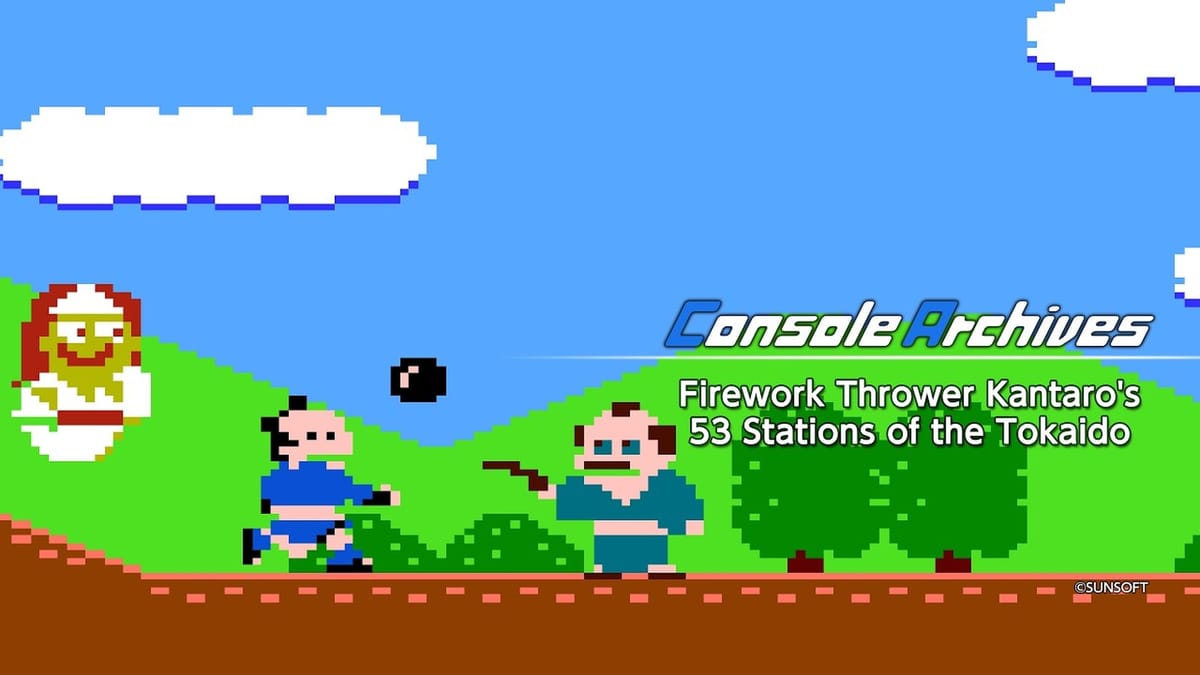
Hamster Corporation is bringing Sunsoft's 1986 Famicom action game Firework Thrower Kantaro's 53 Stations of the Tokaido to the PlayStation 5 and Nintendo Switch 2 on June 4. The release is part of the company's Console Archives series and will cost $7.99.
The game follows Kantaro, a fireworks maker traveling to Edo. He needs to launch a massive display over the Sumida River for his fiancée, Momoko-chan. It is a 2D action-platformer where Kantaro uses his handmade fireworks as his primary weapons. He tosses these explosives at ninjas, bandits, and local wildlife across a variety of historical Japanese environments.
The road to Edo
The title references the actual 53 Stations of the Tokaido. This was a series of rest areas along the coastal route connecting Kyoto to Edo (modern-day Tokyo) during the Edo period. The route is a famous piece of Japanese history and was the subject of a popular series of woodcut prints by artist Utagawa Hiroshige. Sunsoft adapted this long journey into a side-scrolling gauntlet.
Kantaro's journey takes him through bright daytime mountain paths, dark forests, and traditional Japanese villages. The platforming requires careful timing. Kantaro must navigate across rooftops and avoid hazards while dealing with enemy ambushes.
Combat relies entirely on the firework-throwing mechanic. Instead of shooting straight ahead, Kantaro arcs his explosives through the air. Players have to account for this trajectory to hit enemies on different elevations. This gets complicated quickly when blue-robed enemies and rival ninjas start crowding the screen.
Language and localization
The original 1986 cartridge never saw an official release outside of Japan. For this modern digital release, Hamster has translated the user interface and the digital manual into English. The actual in-game text remains in Japanese.
Action platformers from this era rarely rely on heavy text to convey their mechanics. The language barrier should not stop anyone from understanding how to jump and throw explosives. The menus for saving and adjusting settings are fully readable in English.
The Console Archives treatment
Hamster is well known for its massive Arcade Archives catalog. The Console Archives line applies that same treatment to home console games. The emulation wrapper includes several conveniences that 1986 Famicom games usually lacked.
Players can use save states to record their progress at any point during the 53 stages. The release also includes customizable button layouts and rapid-fire settings. Hamster added a rewind function to help players fix missed jumps or accidental deaths.
The display options include adjustable screen layouts and CRT filters. These filters simulate the scanlines and phosphor glow of an old tube television.
Sunsoft had a wildly varied output in the 1980s. Before they established a reputation for pushing the NES hardware with games like Batman and Gimmick!, they experimented heavily with weird, Japan-only concepts. Having access to these early experiments on modern storefronts makes it much easier to explore the studio's chaotic early years.

Comments ()