
F-Zero-style Mode 7 racer ZERO releases for Game Boy Color
Thalamus Digital and Rocketship Park have released ZERO, a $1.99 Game Boy Color racer that uses demoscene tricks to fake SNES Mode 7 graphics.
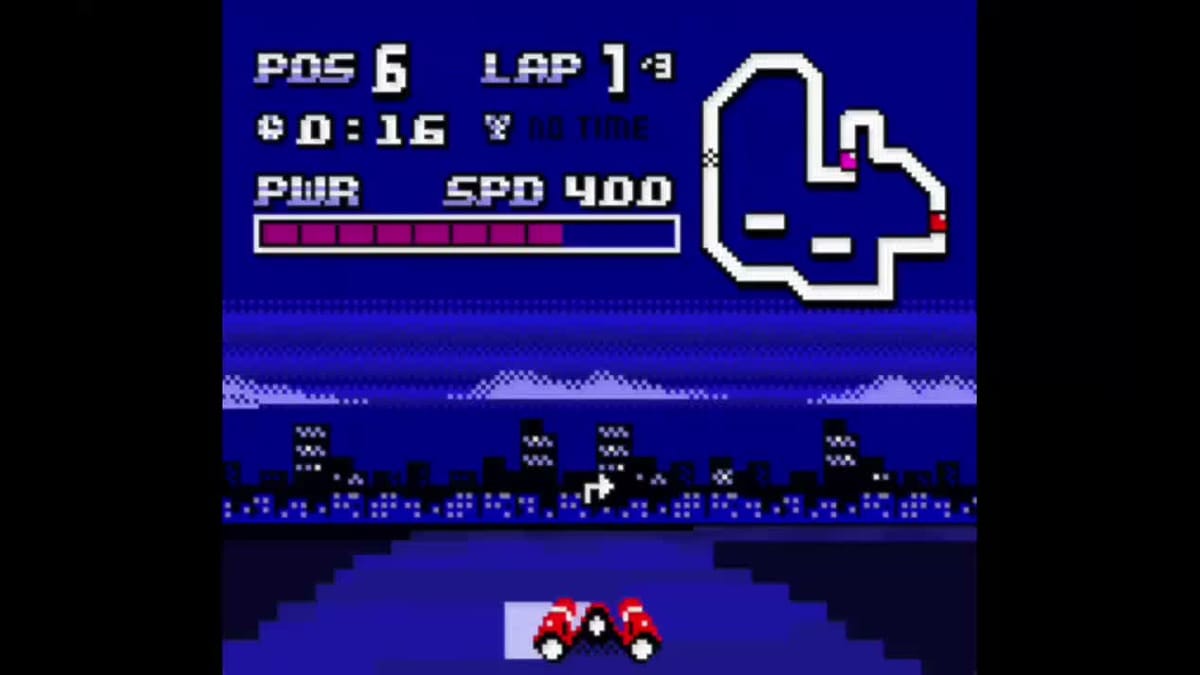
Thalamus Digital and Canadian indie studio Rocketship Park have officially released ZERO, a futuristic arcade racing game for the Game Boy Color that uses demoscene programming tricks to fake Super Nintendo-style Mode 7 graphics. First teased in August 2026 by developer Shane McCafferty, the completed game is available to purchase on itch.io for $1.99.
Because it's distributed as a standard Game Boy Color ROM file, it isn't locked to a single modern storefront or wrapper. You'll be able to run the download on a PC or handheld emulator, load it onto an FPGA system like the Analogue Pocket, or drop it onto a flash cart to play on original 1998 Nintendo hardware.
Faking Mode 7 on an 8-bit CPU
When Nintendo launched F-Zero alongside the Super Nintendo in 1990, the console's hardware could natively scale and rotate flat background layers to create a smooth pseudo-3D track plane. Handheld players had to wait until the 32-bit Game Boy Advance arrived in 2001 with F-Zero: Maximum Velocity to get that same perspective on a portable screen. The 8-bit Game Boy Color has no dedicated scaling or rotation hardware at all.
McCafferty got around that limitation using GB Studio and GBDK2020, pulling techniques straight out of the retro demoscene. Instead of rotating a full background layer in real time, ZERO pre-renders cached 2x2 grid tiles into video RAM and shifts the horizontal perspective line by line using timed scanline interrupts. It's a clever bit of visual sleight of hand, and I'm impressed by how well the sense of speed holds up on an 8-bit processor that was never meant to handle flat-plane 3D rendering.
"The technique was, like all cool things, stolen from the demo scene. The real fun was turning that into something that feels thrilling and fun to play. I hope people have as much fun playing ZERO as I had coaxing it from the Game Boy."
Nine tracks and an 11-unit power reserve
Technical demos on vintage consoles have a habit of fizzling out once you've admired the programming trick for thirty seconds, so McCafferty built an actual game around the engine. ZERO includes nine courses split across three tiered Grand Prix cups: Bronze, Silver, and Gold.
Races revolve around a resource-management mechanic built into your hovercraft's boost gauge. You start each event with 11 power units in reserve. Firing a boost burns three of those units at once, while cleanly overtaking a rival ship puts one unit back in the tank. That math forces you to treat passing as fuel rather than just spamming the boost button on every straightaway.
From Commodore 64 to Game Boy
McCafferty has spent the past few years turning the Game Boy Color into a testbed for genres it shouldn't be able to run. Operating as Rocketship Park, he previously built the first-person raycasting shooter WOLF, a port of the Amiga roguelike Roguecraft, an 8-bit demake of OutRun, and portable racers Nitro and Hero GP.
Almost all of those projects were published by Thalamus Digital, led by CEO Andy Roberts. Older computer collectors will recognize the Thalamus name from the late 1980s and early 1990s, when the UK label published Commodore 64 and ZX Spectrum staples like Creatures, Sanxion, and Armalyte. Its modern revival focuses heavily on tiny homebrew downloads and physical cartridge runs.
There's no word yet on whether ZERO will eventually get a boxed cartridge release alongside its digital ROM, though two bucks is an easy asking price for anyone with an EverDrive sitting in a drawer.
Comments ()