
Ex-Sega engineer adds 'TV tapping' feature to hyper-realistic CRT emulator
GOROman's open-source SDR decoder now lets you physically smack your laptop to fix a fuzzy Famicom picture.
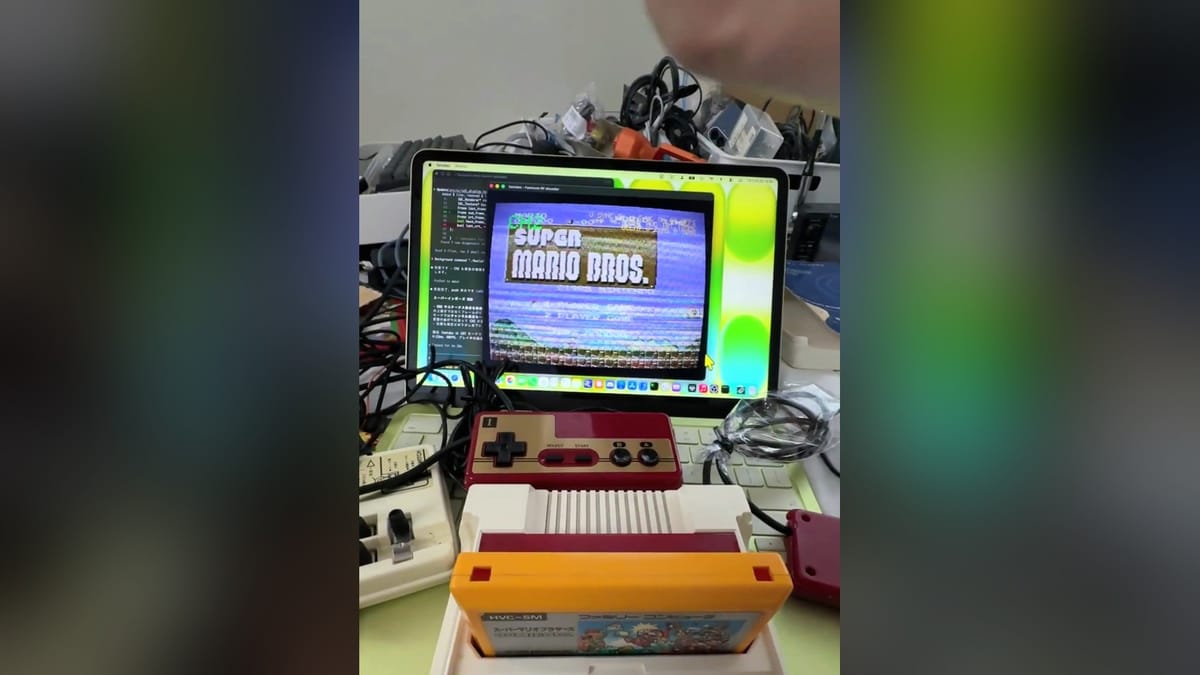
Ex-Sega and ex-Facebook software engineer GOROman has updated his custom Famicom decoder to include a feature we all relied on in the 1980s: percussive maintenance. According to a recent post on X, the software now responds to physical screen tapping to temporarily fix a distorted picture.
The project is called famicom-rf-hackrf-decoder. It is not an emulator in the traditional sense. It is a software decoder that receives actual VHF RF output (NTSC-J) from a physical Nintendo Famicom. It accomplishes this using an open-source software-defined radio (SDR) solution dubbed the HackRF One.
Radio waves over USB
Most retro gaming setups try to bypass a console's RF output entirely. The original 1983 Famicom only outputted radio frequencies designed for Japanese VHF channels 1 and 2. Today, players usually modify the hardware to output composite or RGB video to get a clean picture on modern flat panels. GOROman took the opposite approach.
You plug the Famicom's RF cable directly into the HackRF One's antenna port. The SDR captures the raw analog radio waves at 10 million samples per second over USB. The software then performs real-time NTSC color decoding and FM audio demodulation on your computer.
The HackRF actually tunes 2.0 MHz above the video carrier to keep its DC spike out of the signal, then shifts it back down in software. Real RF modulators also drift over time. GOROman's specific test unit outputs its channel 1 video carrier at 90.83 MHz, which is 420 kHz below the nominal frequency. The software includes a spectrum analyzer mode to help users find their exact carrier frequency if the video sync fails. The entire project is built using C++20 and SDL2, running natively on macOS and Linux.
Hitting the hardware
GOROman originally demonstrated the visual side of the project earlier this week. The initial video highlighted heavy barrel distortion, aggressive scanlines, and intense signal noise. The community immediately asked for a way to fix the static. The solution was adding support for physical impacts.
The software detects when you tap or smack your laptop. It instantly stabilizes the simulated CRT image. This perfectly mimics the childhood ritual of slapping a malfunctioning television set with a loose connection. The picture stays clear for a moment before slowly degrading back into static.
I miss hitting my electronics
Modern emulation usually focuses on pixel-perfect clarity. We spend hundreds of dollars on upscalers to strip away the analog messiness of vintage hardware. GOROman used a high-end SDR peripheral to perfectly capture that mess, then wrote code to let you punch it.
It makes sense given the developer's background. GOROman (real name Tatsuya Okadome) has a long history of bridging weird hardware gaps. Before creating this decoder, he worked as a software engineer at Sega and Facebook, and played a major role in early VR evangelism in Japan. He understands how to make digital spaces feel physical.
The decoder software is available for free right now. You just need a $300 radio peripheral, an original Famicom, and a willingness to slap your monitor.

Comments ()