
CardCat just added a ton of new Apple II hardware detections
Henry Lowe's CardCat utility has been updated to version 1.94, adding detection for FujiNet, the PC Transporter, and dozens of other Apple II expansion cards.
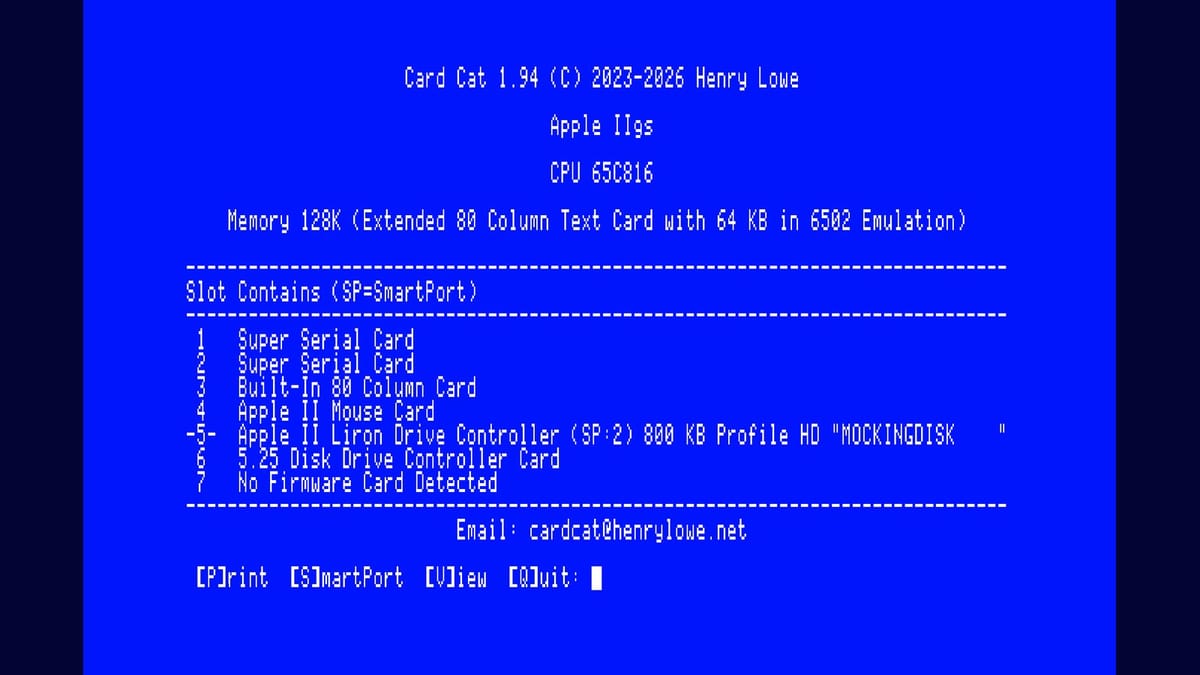
Developer Henry Lowe has released version 1.94 of CardCat, a utility program that identifies and catalogs expansion cards installed in Apple II computers. The update adds detection for dozens of new and vintage hardware components, including modern network adapters like FujiNet and classic hardware like the Applied Engineering PC Transporter. The software is available to download directly from Lowe's personal site, as announced in an article on Call-A.P.P.L.E..
The Apple II series was built around expandability. When Steve Wozniak designed the original 1977 machine, he included eight internal expansion slots. This open architecture spawned a massive third-party hardware market over the next two decades. Users could install memory expansions, 80-column video cards, printer interfaces, and even coprocessors that let the machine run CP/M or MS-DOS software. Today, collectors often acquire vintage Apple II systems with undocumented cards stuffed into every available slot. CardCat exists to tell users exactly what hardware is sitting inside their machines without requiring them to pull the chips and look up part numbers.
Spotting the PC Transporter
Version 1.94 expands the utility's database to recognize a mix of original 1980s hardware and modern aftermarket projects. On the vintage side, the software now identifies the PCPI Applicard and the Applied Engineering PC Transporter. The PC Transporter was an ambitious piece of hardware from the late 1980s that essentially put an entire IBM PC clone on a single Apple II expansion card. CardCat also now recognizes the Apple High-Speed SCSI card, the Apple II Graphics Tablet Interface, the CPS-Laser Universal Disk Controller, and several parallel printer interfaces from Epson and TYMAC.
FujiNet and modern network adapters
The update also focuses on hardware developed long after the Apple II was discontinued. CardCat 1.94 detects modern storage and networking solutions like the A2RetroNet, the A2Pico, and the FujiNet adapter. FujiNet originally started as an Atari 8-bit project but has since expanded to the Apple II, allowing the vintage computer to connect to modern Wi-Fi networks and load disk images directly from the internet. Recognizing these newer devices makes CardCat a practical diagnostic tool for users bridging the gap between 1980s hardware and modern home networks.
Built-in hardware and the Laser 128
Beyond expansion cards, Lowe improved how the software detects built-in system hardware. CardCat now correctly identifies the integrated 80-column display hardware on both the Apple IIe and the portable Apple IIc. The Apple IIe, released in 1983, became the longest-produced model in the family, and its 80-column text support was a major selling point for business users. Lowe states that the utility also flags the exact slot containing the startup disk by displaying it as a numbered value on the screen. Lowe also reports that the interface has been cleaned up to standardize memory and storage size units using standard kilobytes and megabytes.
The update even extends support to unauthorized clone hardware. Version 1.94 adds firmware identification for the Laser 128. Released by VTech in 1986, the Laser 128 was a highly successful Apple IIc clone that managed to reverse-engineer Apple's ROMs without triggering a successful copyright lawsuit. Unlike the official Apple IIc, the Laser 128 included a side expansion slot, making CardCat's diagnostic tools just as useful for clone owners as they are for users with original Apple hardware.



Comments ()