
CachyOS adds Easy Anti-Cheat Linux v2 support with a signed kernel
CachyOS's November 2026 release ships an opt-in signed kernel for Epic's Easy Anti-Cheat Linux v2, alongside Package Installer 2.0 and USB-free recovery.
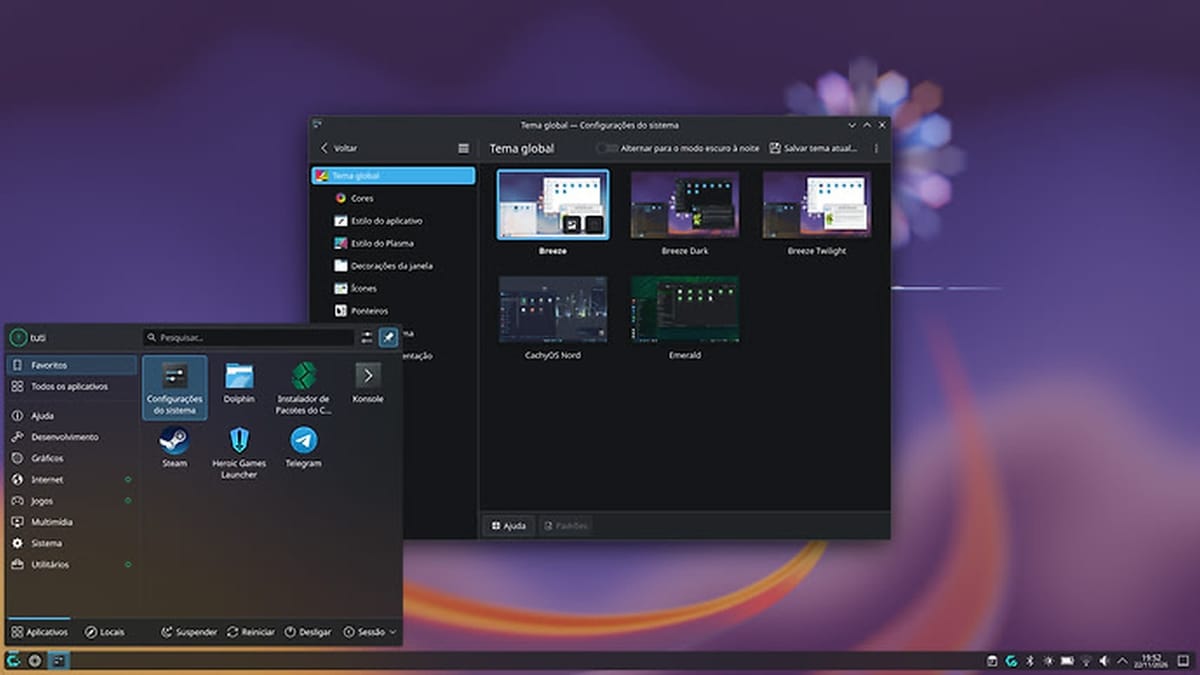
Arch-based distribution CachyOS launched its November 2026 release (ISO build 261122) on Sunday, introducing out-of-the-box support for Epic Games' Easy Anti-Cheat Linux v2 through a dedicated signed kernel and automated boot tools. It's the project's sixth ISO refresh of the year, arriving alongside a redesigned Package Installer 2.0, a bootloader-launched recovery image, and an official Windows 11 WSL build.
Epic announced Easy Anti-Cheat Linux v2 on October 14 alongside a native Linux preview of the Epic Games Launcher, laying the groundwork to bring Fortnite and other protected multiplayer games to Linux. Rather than installing a proprietary kernel driver like the Windows version does, EAC Linux v2 runs a systemd service and eBPF kernel programs while a game is open, backed by strict hardware attestation. Games won't start unless the PC boots with UEFI Secure Boot, TPM 2.0 measured boot, an enabled IOMMU, kexec disabled, an active BPF LSM, and kernel lockdown in integrity mode. That lockdown requirement rejects unsigned DKMS modules and custom kernels, which immediately clashed with how rolling-release gaming distros usually operate.
A separate boot entry for anti-cheat games
CachyOS works around that conflict by leaving the user's primary system alone. The update adds an optional linux-cachyos-eac kernel and a matching systemd-boot binary signed with CachyOS's key, installing them on a separate boot entry so players don't have to give up custom tweaks or unsigned drivers during everyday use. As lead developer Peter Jung put it, "your normal boot entries are kept, so you only boot into it when you want to play a game that uses EAC."
Two new utilities in cachyos-settings, eac-setup and eac-status, configure and verify the Secure Boot chain across systemd-boot, Limine, and rEFInd, with experimental support for GRUB. Because kernel lockdown blocks DKMS compilation, CachyOS ships prebuilt, signed linux-cachyos-eac-* driver packages for NVIDIA (both open and 580xx branches), ZFS, and Realtek r8125 networking. Keeping the locked-down environment quarantined to its own boot entry is a clean compromise for an Arch derivative, though there's still a catch: games won't actually clear attestation until Epic adds CachyOS's signing key to its trusted list and individual publishers flip the switch on Linux support. Dual-booters using Windows BitLocker or TPM disk unlocking will also want to read the project's wiki first, since altering Secure Boot keys changes TPM measurements.
From custom kernel to full gaming distro
Founded in July 2021 by Peter Jung (ptr1337) and Vladislav Nepogodin (vnepogodin), CachyOS started as a set of performance-patched Arch Linux kernels and packages recompiled for newer x86-64 CPU microarchitectures. Five years later, the Framework-sponsored project ships Desktop Edition and WSL images alongside a Handheld Edition tailored for x86 portables like the Steam Deck, Asus ROG Ally, and Lenovo Legion Go, though a dedicated Server Edition build has not yet been released, with only experimental Server Edition CLI installer profiles and the linux-cachyos-server kernel package available. (Steam Deck owners shouldn't expect EAC Linux v2 miracles yet, as Epic noted in October that Valve's handheld still lacks the firmware features required for its boot checks.)
Package Installer 2.0 and USB-free recovery
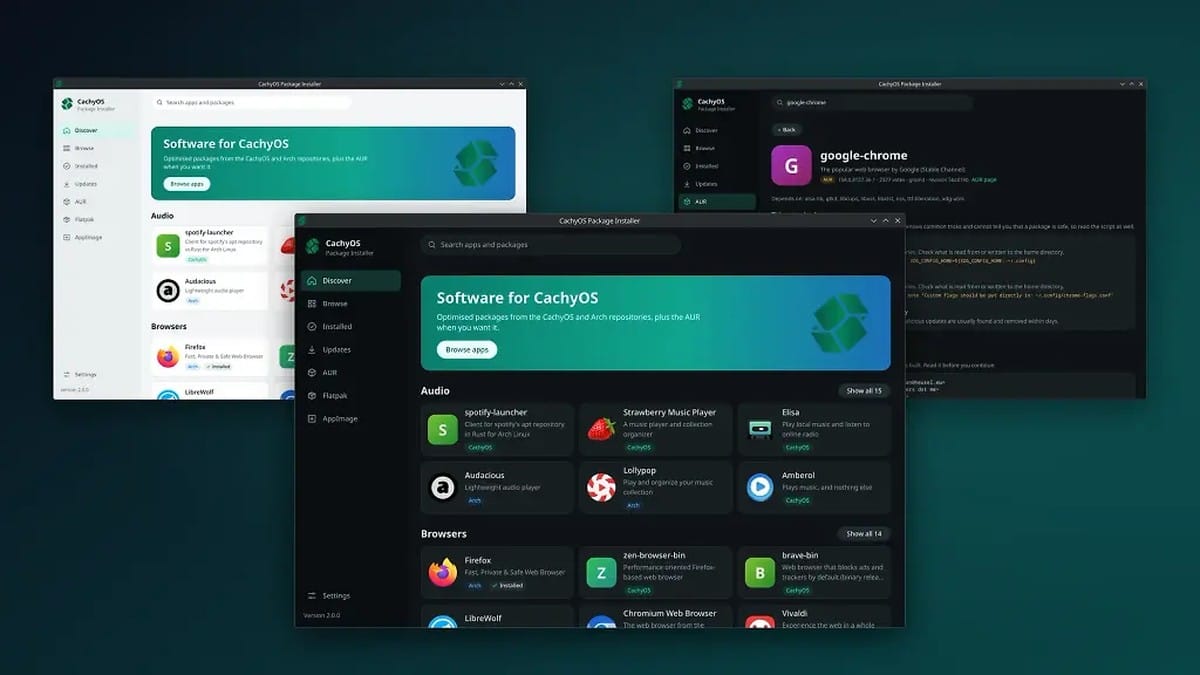
Outside of anti-cheat, the November ISO updates the default software stack to Linux kernel 7.3.5 (with 6.18.64 LTS as an alternative), Mesa 26.3.1, NVIDIA 620.73.04 drivers, KDE Plasma 6.8.3, and proton-cachyos 11.0-20261015. CachyOS Package Installer 2.0.0 replaces Shelly as the default GUI package manager, adding opt-in support for Flatpaks, AppImages with GitHub update tracking, and AUR builds. Before compiling anything from the AUR, the installer displays the PKGBUILD and runs static analysis to flag suspicious lines, which beats blindly trusting community scripts in a terminal.
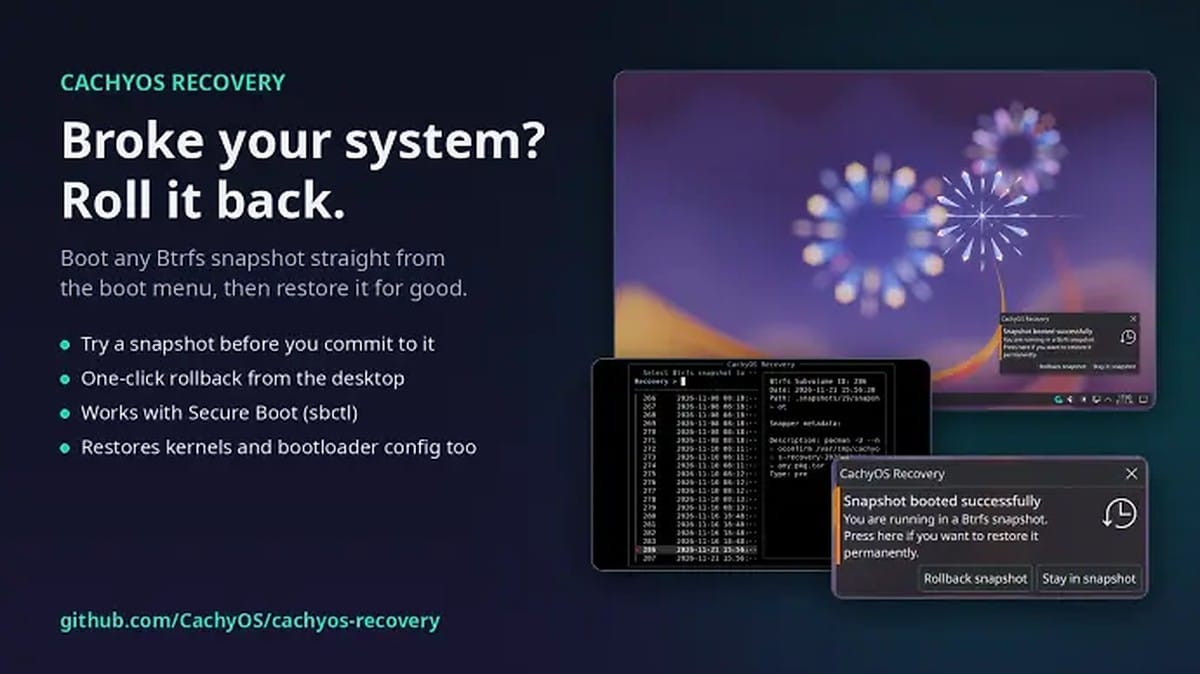
The release also introduces cachyos-recovery, a self-contained image that boots straight from UEFI or the boot menu without needing a spare thumb drive. It mounts Btrfs snapshots with a writable root, even on LUKS-encrypted drives, letting users test whether an older snapshot actually fixes a broken update before making the rollback permanent. I'm curious whether other Arch-based distros will copy the dual-kernel layout once Fortnite finally lands on Linux, because asking tinkerers to permanently lock down their daily kernel was never going to fly.

Comments ()