
BurgerDisk just got DOS 3.3 image support, but there's a catch
Colin Leroy-Mira's BurgerDisk and DominoDisk just received a firmware update that lets Apple II users load DOS3.3-ordered .dsk images directly.
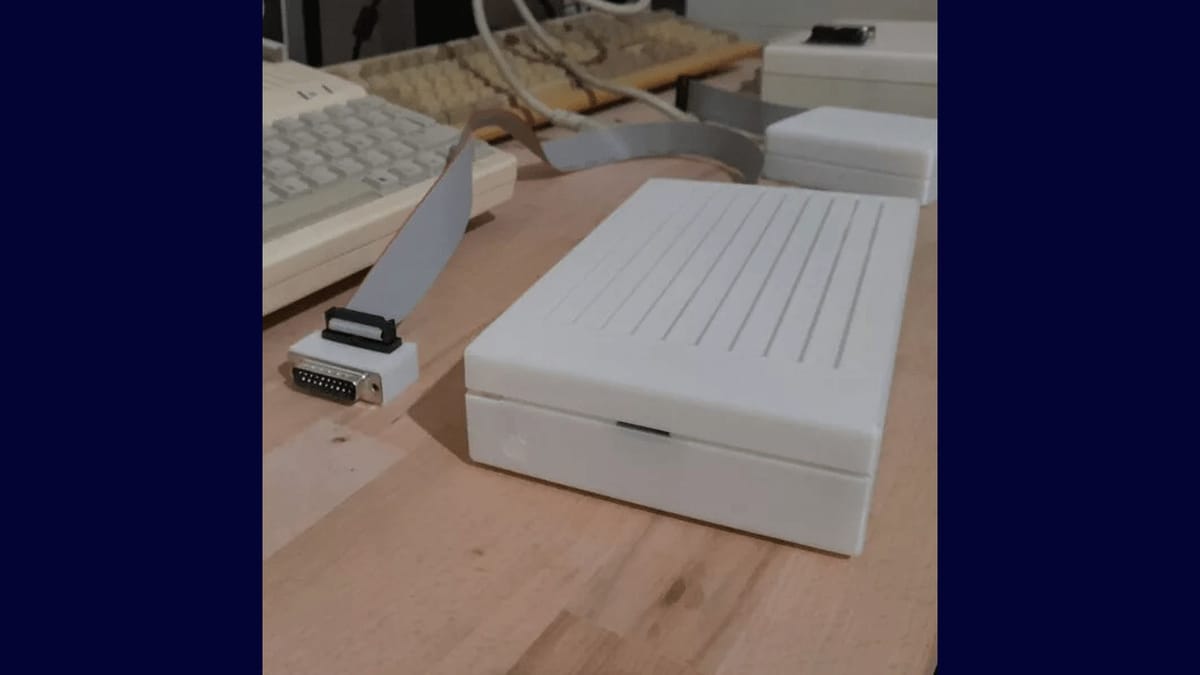
Colin Leroy-Mira has released firmware version 2.6 for the BurgerDisk and DominoDisk, adding direct support for DOS3.3-ordered .dsk images of ProDOS volumes. The update is available now, and all new units shipping from his store already include the patch.
Leroy-Mira launched the BurgerDisk earlier in 2026 as an SD-card-based Smartport hard drive. He followed it up in March with the DominoDisk, a more compact variant designed to tuck neatly under a monitor stand. Both devices target the Apple II ecosystem. They are built specifically for non-slotted models like the Apple //c, though they work across the broader Apple II family.
Their main selling point is the ability to daisy-chain other Smartport devices and original floppy drives. This is a massive benefit for Apple II users. Original hardware setups often involved stacking multiple disk drives to avoid constant disk swapping during gameplay. By allowing the BurgerDisk to sit in a chain with original Disk II drives, users can easily transfer files from an SD card to a physical floppy. You can also just keep your original hardware plugged in for authenticity while using the SD card for bulk storage.
Reading and writing twice
The big addition in version 2.6 is convenience, according to Call-A.P.P.L.E. Previously, running certain disk images required converting .dsk files into .po (ProDOS-ordered) images. The new firmware handles DOS3.3-ordered images natively.
There is a noted performance penalty. Leroy-Mira explains that handling DOS3.3-ordered images requires the firmware to cut ProDOS blocks into two separate sectors. The drive then has to seek twice and perform read and write operations twice. If you want maximum speed, you should stick to .po images. If you just want to drag and drop an existing .dsk archive onto an SD card without running batch conversion scripts, this update saves you that step.
Decades of floppy disks
To understand why this matters, you have to look back at how Apple II software was distributed. DOS 3.3 launched in 1980 and became the foundational operating system for early Apple II games. Titles like Akalabeth and the original Wizardry relied heavily on this disk structure. DOS 3.3 used a 16-sector format that was highly advanced at the time.
Apple introduced ProDOS in 1983 to handle larger storage devices and provide a better file system. ProDOS reorganized how data was stored to speed up access times and support hard drives. That fundamental difference in sector ordering is exactly why the BurgerDisk has to work twice as hard to read a .dsk file today. ProDOS became the standard for later software. However, a massive library of early 1980s history was already locked into the DOS 3.3 format.
Modern Apple II users often have massive folders full of .dsk files. Original 5.25-inch floppy disks are increasingly fragile, making solid-state solutions like the BurgerDisk mandatory for playing on original hardware. Building native support into the drive means less friction when trying to boot up a 40-year-old piece of software.
Pre-installed on new units
The firmware update is live on Leroy-Mira's GitHub page. If you buy a new unit directly from his shop, the hardware will ship with version 2.6 pre-installed.
I appreciate hardware developers who continue pushing quality-of-life updates months after a product launches. The BurgerDisk was already a highly capable Smartport solution, and removing the need to manually convert disk images just makes it easier to use.
Comments ()