
Atari 2600 classic Adventure is now playable on the Apple II
Homebrew developer Dagen Brock has released a free, complete Apple II port of Warren Robinett's 1979 Atari 2600 classic, Adventure.
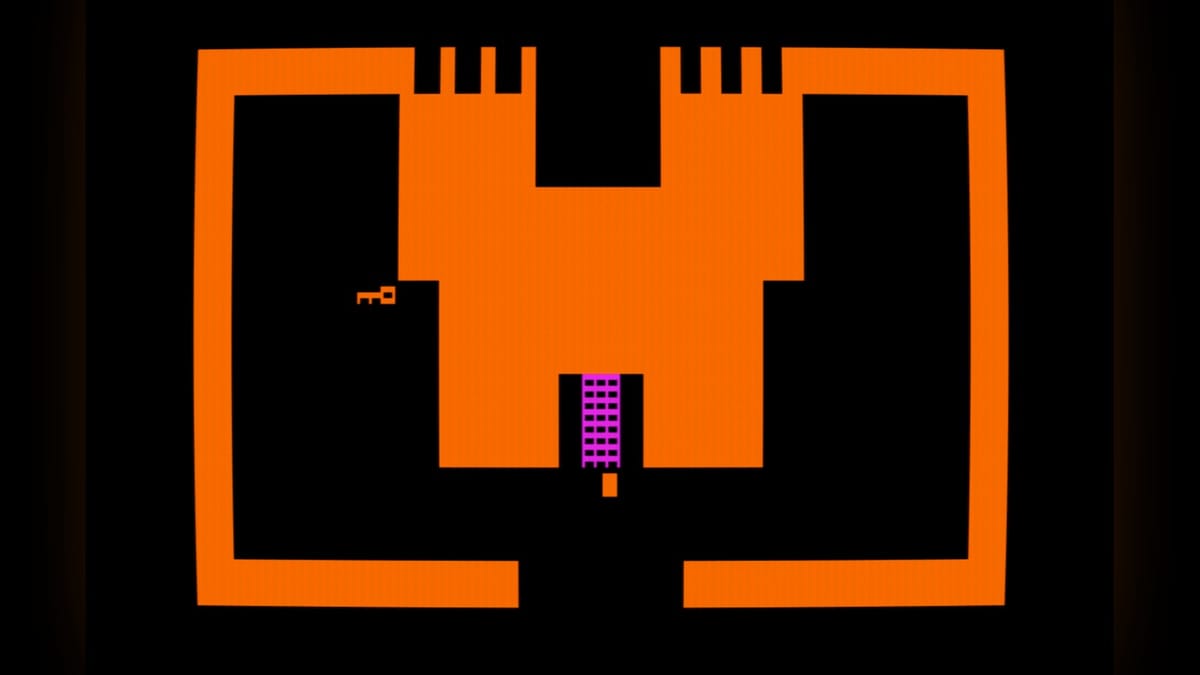
Homebrew developer Dagen Brock has released a complete Apple II port of Warren Robinett's 1979 Atari 2600 classic, Adventure. The game is available now as a free download through Call-A.P.P.L.E. and Brock's personal site.
Brock is best known in the vintage computing scene for his 2014 Apple II demake Flapple Bird. His new project brings the foundational action-adventure game to Steve Wozniak's 8-bit hardware. It features all the mechanics, dragon behaviors, and maze layouts from the original cartridge. It even includes the famous hidden room where Robinett secretly coded his name to bypass Atari's strict no-credits policy.
You are still a square
Adventure originally hit the Atari 2600 in 1979. It translated the text-based exploration of Colossal Cave Adventure into a graphical, real-time world. You control a literal square. Your job is to traverse multi-screen mazes, avoid dragons that look suspiciously like ducks, find keys, and return an enchanted chalice to a golden castle.
I am curious how the Apple II keyboard controls feel compared to a standard Atari joystick, especially when trying to outrun Yorgle. The original game relied heavily on the Atari's single-button joystick for picking up and dropping items. Mapping that to a keyboard isn't a massive hurdle, but getting the timing right when a dragon is bearing down on you is another story.
The dragons themselves are fully intact. Yorgle the yellow dragon, Grundle the green dragon, and Rhindle the red dragon all retain their original behaviors and speeds. Rhindle is still the fastest, and he'll still ruin your day if you aren't paying attention.
That one gray pixel
The most famous part of Adventure is its Easter egg. Atari management refused to put developer names on boxes to prevent competitors from poaching their talent. Robinett responded by hiding his name in a secret room, accessible only by carrying a tiny, one-pixel gray dot through a specific wall in the black castle catacombs.
Brock made sure this dot and the secret room survived the transition to the Apple II. It wouldn't be Adventure without it.
The Apple II launched in 1977, the exact same year as the Atari 2600. Despite existing in the same era, the two systems handled graphics and memory very differently. Moving a console game built around the Atari's television-driven display chip over to the Apple II's unique memory-mapped video system takes serious work.
Brock had to rebuild the logic from scratch to make the game feel authentic on a computer platform. The Atari 2600 only had 128 bytes of RAM. The Apple II had significantly more memory, but its graphics rendering quirks are notorious among programmers. Getting the movement and object collision to match Robinett's original vision is impressive. It works, which is the nicest thing I can say about any homebrew port of a 47-year-old game.
Free to download
The port is out now. You can grab the disk image directly from Brock's retro portal. It runs on original Apple II hardware if you have a way to write the disk, and it works perfectly in modern emulators.
There aren't many developers actively porting Atari games to the Apple II in 2026. If you have an Apple II setup collecting dust, that's a good reason to turn it on.
Comments ()