
Armor Attack is joining the Vectrex Mini's built-in lineup
Neo Retro has added Tim Skelly's 1980 war shooter Armor Attack to the Vectrex Mini's built-in roster, showing prototype footage ahead of an early 2027 launch.
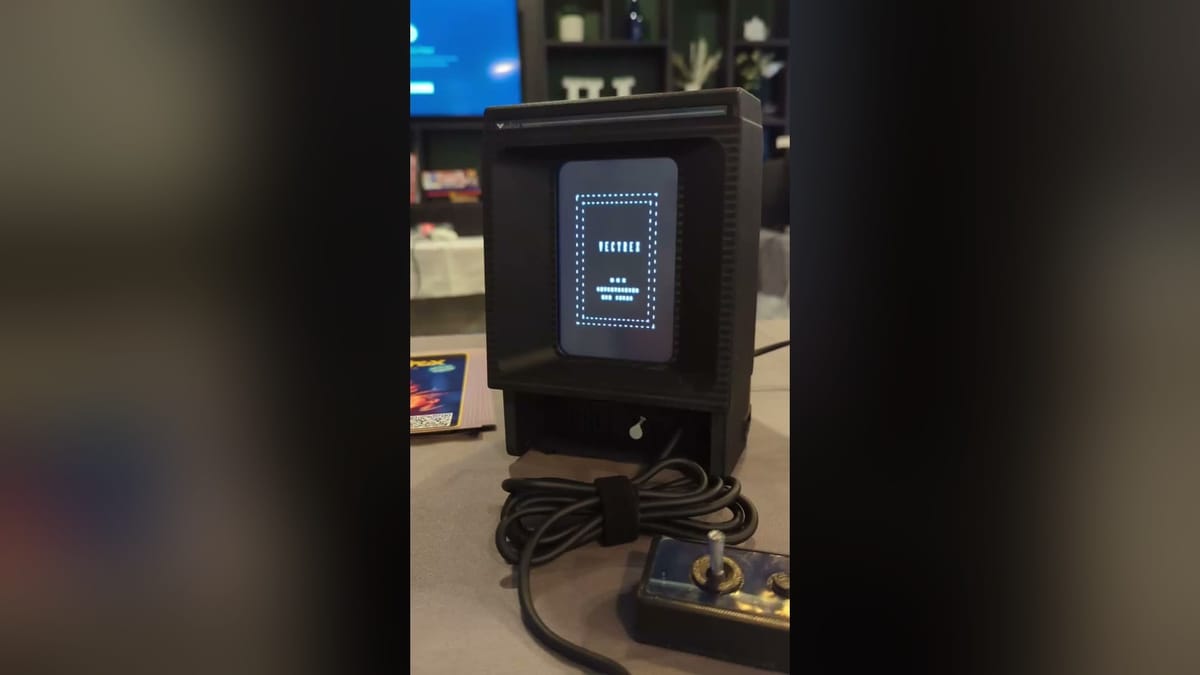
Paris-based hardware company Neo Retro has confirmed that the top-down war shooter Armor Attack will be one of the 14 built-in games on the Vectrex Mini. Vectrex shared gameplay captured on a working prototype over the weekend, showing an armed jeep threading between enemy tanks and overhead helicopters while the half-scale console sits in manufacturing.
Armor Attack fills the 14th mystery slot alongside previously confirmed pack-ins MineStorm, Spike, Bedlam, Spinball, Clean Sweep, and Fortress of Narzod. While Neo Retro's November 2025 Kickstarter pitch originally listed MineStorm II and Cosmic Chasm, the updated 13-game lineup revealed in June 2026 omitted Cosmic Chasm and listed the original MineStorm instead, a choice Neo Retro's official Bluesky account reaffirmed in July and November 2026. What stands out in the new clip is how readable those glowing lines remain at half scale, even before you factor in the translucent screen overlay that gives the barren streets any actual architecture.
From Cinematronics cabinets to living rooms
Tim Skelly designed and programmed Armor Attack at Cinematronics, which put it into arcades in 1980 and licensed the cabinet out to Rock-Ola and to Sega in Japan. It was Skelly's final in-house project for the studio after earlier vector hits like Warrior, Rip Off, and Star Castle, before he moved on to design Reactor at Gottlieb and later worked at Sega Technical Institute. General Consumer Electronics (GCE) brought the game home in October 1982 as one of the original 12 launch-era titles for the Vectrex.
One or two simultaneous players steer jeeps around a town maze, firing rockets at tanks that take one hit to stall and a second hit to destroy, while a helicopter ignores the street grid completely to strafe from directly overhead. Because the 1982 Vectrex used a monochrome 9-inch CRT vector monitor with zero background graphics, the city walls weren't even rendered in code: they were printed onto a green-tinted plastic sheet you slid over the glass. Losing that piece of plastic meant driving around an empty void and crashing into invisible geometry, which was an early lesson in why physical media storage matters.
Outside of tracking down original 1982 cartridges after Milton Bradley discontinued the Vectrex in early 1984, official ways to play Armor Attack have been scarce. Its last notable commercial appearance was inside Rantmedia's 2012 iOS app Vectrex Regeneration, which has been delisted from the App Store for years.
An IPS screen swap and an early 2027 window
Project lead David "Flynn" Oghia and Neo Retro funded the Vectrex Mini on Kickstarter between November 3 and December 2, 2025, raising €1,211,184 from 6,069 backers at a €149 (roughly $173) Standard Edition tier. After five years of development, the hardware has gone through a few late-stage changes on its way to the factory floor. Delivery slipped past its initial September 2026 estimate into an early 2027 retail window, and in October 2026 the team replaced the originally pitched 5-inch AMOLED panel with a 5-inch 800x480 IPS LCD running on an ESP32-P4 processor, citing part costs, burn-in risks, and processor limits.
Trading true OLED blacks for an IPS panel on a machine built entirely around bright white lines in pitch darkness is a tough sell on paper, and I'm curious how well the physical overlays mask the LCD backlight glow in a dark room. Alongside the screen change, Neo Retro bumped the built-in library from 12 games to 14, keeping the miniaturized color overlays, wireless Bluetooth controller, USB-C power, video output, and microSD card slot for loading homebrew ROMs (it doesn't take original Vectrex cartridges).
Anyone near London won't have to wait until next year to judge the new panel in person. Neo Retro is holding a launch event at The Lower Third on Saturday, November 21, 2026, with playable test units, indie Vectrex developers, and a talk from Oghia.
Comments ()