
Apple IIGS gets Wi-Fi support through new BlueSCSI drivers
Antoine Vignau has released new GS/OS SCSI drivers that allow Apple IIGS computers to connect to wireless networks using BlueSCSI hardware.
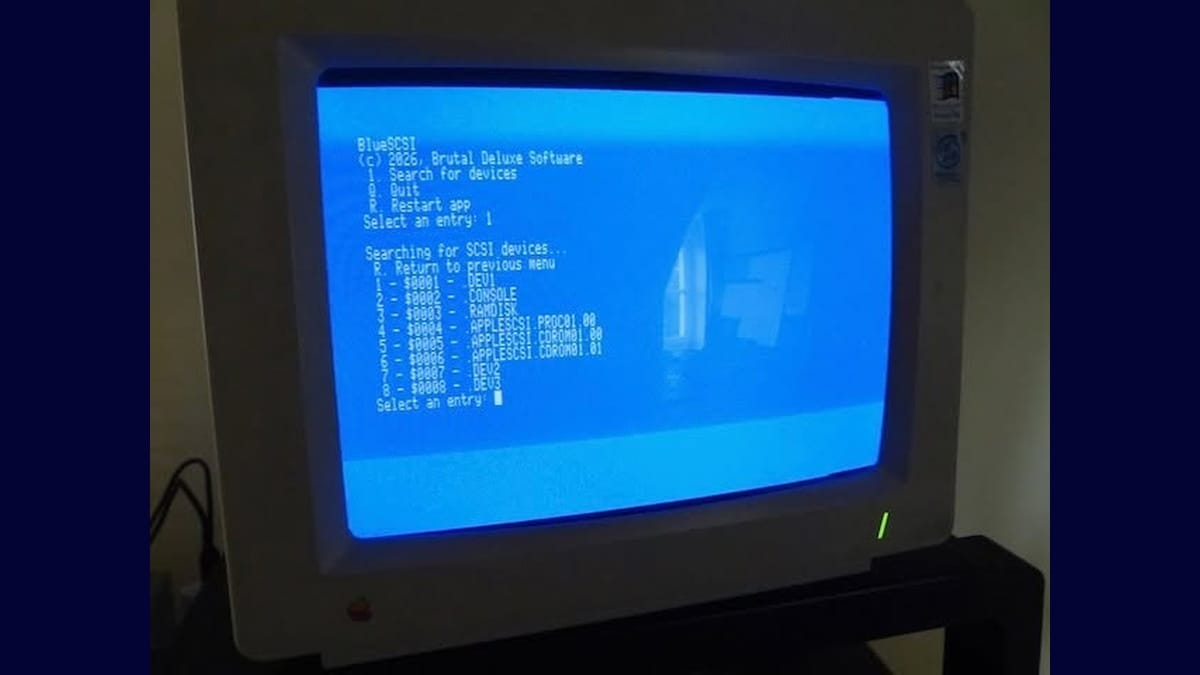
Developer Antoine Vignau has released new SCSI drivers for Apple's GS/OS operating system, enabling Apple IIGS computers to connect to Wi-Fi networks using BlueSCSI hardware. The drivers target Processor and Communication device classes, expanding the capabilities of modern storage replacements beyond simple file storage.
The release was highlighted by Call-A.P.P.L.E. and includes full source code, documentation, and preconfigured disk images.
BlueSCSI launched in 2021 as an open-source hardware project. It uses a Raspberry Pi RP2040 microcontroller to emulate mechanical SCSI drives, reading and writing data to standard SD cards. Mechanical SCSI hard drives are loud, slow, and increasingly prone to catastrophic failure from bearing wear and stiction. Replacing them with solid-state media is standard practice in retrocomputing, but BlueSCSI's recent hardware revisions added Wi-Fi connectivity through DaynaPORT emulation.
Treating a hard drive as a network card
The original Apple IIGS did not include built-in SCSI ports. Users had to rely on expansion boards like the Apple II SCSI Card or the RamFAST SCSI, which are now decades old and prone to component failure. Vignau's new Processor Devices driver bridges the modern BlueSCSI hardware capability to the Apple IIGS. It supports the full set of GS/OS TOOLBOX calls, allowing the 16-bit operating system to interact directly with the wireless access point.
GS/OS handles hardware through a modular system of device drivers and File System Translators. By targeting the Processor and Communication device classes instead of standard block storage, the new drivers allow the operating system to recognize the BlueSCSI device as a communication interface. The release includes a Communication Devices driver built as a direct clone of the Processor driver to handle these network requests.
Writing a Marinetti link layer
Getting a 1988 operating system onto a modern wireless network requires a bit of translation. The Apple IIGS relies on Marinetti, a third-party TCP/IP network stack originally developed in the late 1990s by Richard Bennett, to handle internet protocols. Before Marinetti, the machine relied primarily on AppleTalk for local networking.
Vignau provided reference documentation on GitHub to help users write custom link layers for Marinetti. Once configured, this setup allows the vintage hardware to negotiate IP addresses and route traffic through the BlueSCSI's wireless connection. The repository includes disk images with the necessary files to test the implementation.
Decades of Apple II development
Vignau is a co-founder of Brutal Deluxe Software and has been writing system tools for the Apple II family since the early 1990s. His previous work includes preservation utilities and modern hardware interfaces that keep the platform viable.
Apple introduced GS/OS in 1988 with System Software 4.0. It gave the IIGS a graphical Finder similar to the Macintosh and remained the primary desktop environment for the machine's commercial lifespan. Adding Wi-Fi support to an operating system designed before the invention of the modern web is a complex technical exercise, but it keeps the hardware functional in a contemporary network environment.



Comments ()