
Anbernic's new RG DDS is a dual-screen handheld built for 3DS
The clamshell Android handheld features a Snapdragon G2 Gen 2 and two screens designed specifically for exact 3x integer scaling of Nintendo 3DS games.
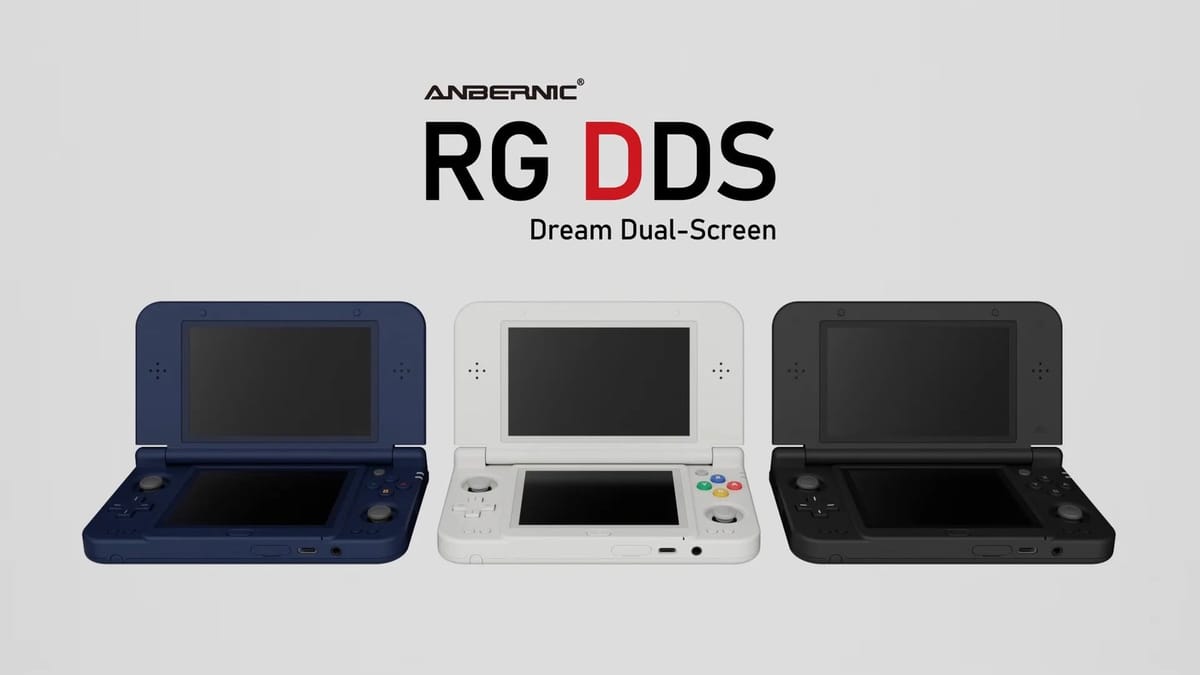
Anbernic has announced the RG DDS, a clamshell Android gaming handheld built around a dual-screen layout. The device uses a Qualcomm Snapdragon G2 Gen 2 processor and features two discrete displays designed specifically for Nintendo 3DS emulation.
Details surfaced via forthenext, confirming the hardware specifications. The top screen is a 4.7-inch 5:3 panel running at 1200x720. The bottom is a 4-inch 4:3 touch display at 960x720.
Emulating the Nintendo DS and 3DS on a single screen has always been an awkward compromise. You either stack the screens vertically on a standard 16:9 display, which leaves massive black bars on the sides, or you put them side-by-side and shrink the image until it's barely readable. Dedicated dual-screen hardware solves the layout problem, but the RG DDS goes a step further with its panel choices.
Perfect 3x integer scaling
Those exact screen resolutions aren't arbitrary. The original Nintendo 3DS output 400x240 on its top screen and 320x240 on the bottom. Multiplying those numbers by three gives you exactly 1200x720 and 960x720. The RG DDS provides a true 3x integer scale for 3DS games. This eliminates the blur and shimmering that happens when emulators stretch a low-resolution image to fit a modern widescreen display. Every pixel scales perfectly.
The Snapdragon G2 Gen 2 and Adreno A22 GPU provide more than enough power to push those pixels. The hardware supports Mesa Turnip drivers, which are open-source Vulkan drivers heavily utilized by Android emulators for better performance and graphical accuracy.
With this chipset, the RG DDS is capable of emulating the entire Nintendo DS and 3DS libraries at full speed. Beyond the dual-screen systems, that processor will easily handle GameCube, PlayStation 2, and Wii games. The Turnip driver support also means it should run a significant portion of the Nintendo Switch catalog through emulators like Sudachi or Yuzu, assuming you don't mind mapping a single-screen game across a clamshell device.
Stacking up against the AYN Thor
The dedicated dual-screen handheld market crowded up quickly this year. Anbernic already released the lower-powered RG DS and RG DS Plus, but the RG DDS is positioned as a flagship device. I am curious to see how it compares directly to the AYN Thor and the Retroid Pocket Duo once it ships.
The AYN Thor took an early lead in the premium clamshell space, but Anbernic's inclusion of exact 3x integer scaling might give the RG DDS an edge for purists who want their games to look as sharp as possible. The Thor relies on higher-resolution panels that don't map perfectly to the original 3DS output, requiring bilinear filtering or shaders to smooth out the image.
The rest of the RG DDS spec sheet includes a 6,000mAh battery, front-firing speakers, and a new vibration engine. Anbernic also integrated an extendable stylus into the shell, which is practically a requirement for a device aimed at the DS family.
Anbernic hasn't confirmed a release date or pricing yet, though the hardware appears finalized.
Comments ()