
Sega's internal metrics just revealed how Sega Channel really affected game sales
The Video Game History Foundation has unearthed marketing data from 1995 that finally answers whether Sega's cable TV service cannibalized retail cartridges.
The Video Game History Foundation has published newly unearthed internal data about the Sega Channel's direct effect on retail game sales and subscriber metrics. Recovered from the archives of former Sega Channel vice president of programming Michael Shorrock, the numbers give us a rare look at how Sega measured the success of its pioneering digital distribution platform in the mid-1990s.
I never had the Sega Channel, but I always wanted it. For a kid in 1994, the concept sounded like pure science fiction. You plugged a bulky adapter into your Genesis, connected a coaxial cable from your wall, and suddenly had access to 50 rotating games every month. It was Xbox Game Pass decades before broadband existed, and it ran entirely over standard television cable networks. The service launched at a time when fewer than three percent of households in the United States had internet access. Sega partnered with Time Warner Cable and TCI to broadcast the data stream alongside regular television channels.
The library wasn't just old catalog titles. Sega used the network to distribute exclusive games that never saw a physical release in the United States, like Game Freak's Pulseman and Mega Man: The Wily Wars. They even pushed out special modified versions of games like Primal Rage with reduced file sizes to fit within the adapter's strict memory limits.
Retailers were terrified
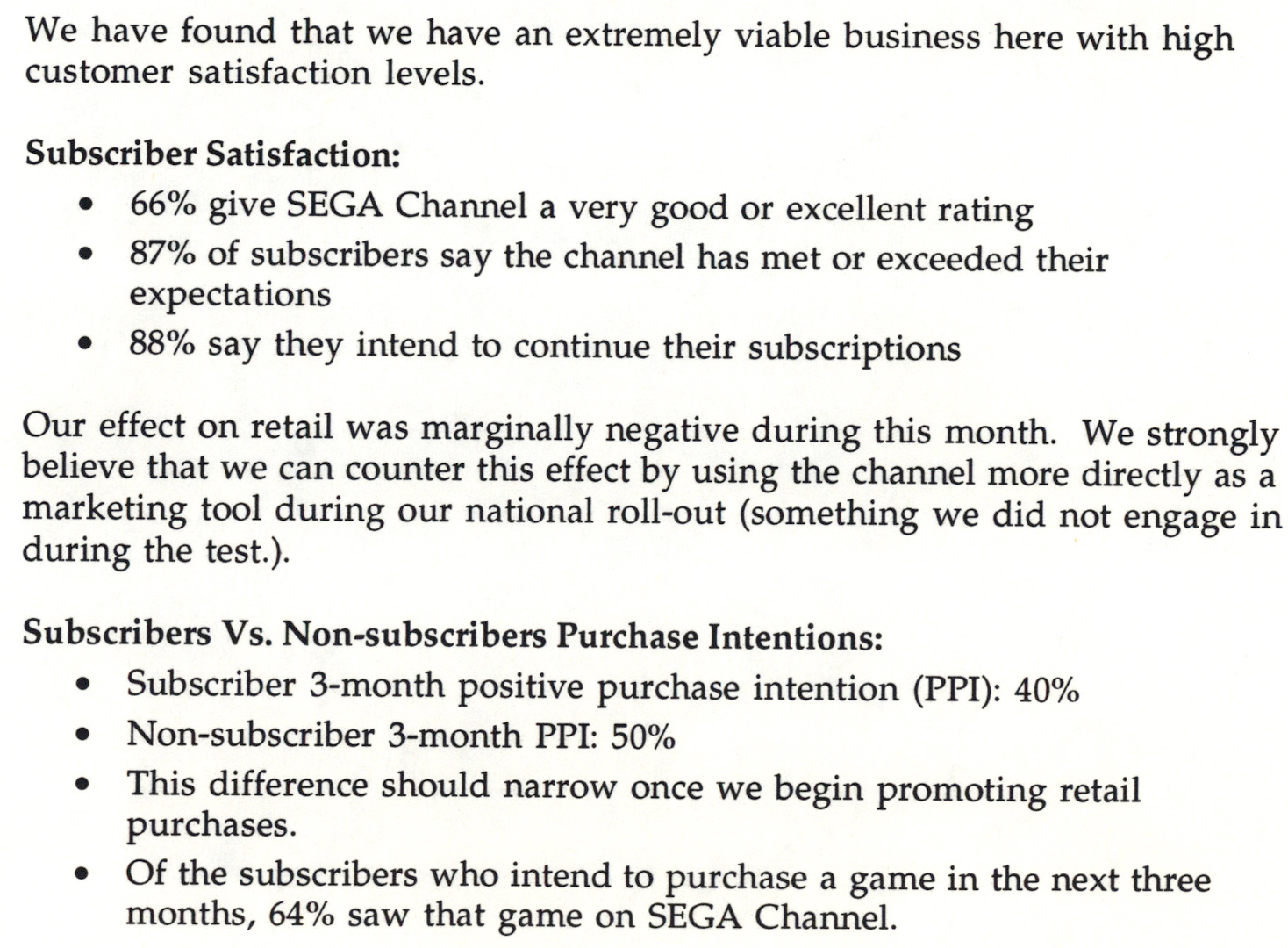
The biggest question surrounding the service was always cannibalization. Did giving players unlimited access to games stop them from buying physical cartridges? At the time, brick-and-mortar retailers were highly suspicious of the Sega Channel. Blockbuster Video and local rental shops were particularly nervous. Their entire business model relied on players paying three bucks to rent a game for the weekend. Sega Channel offered an entire month of unlimited play for about fifteen dollars, plus a twenty-five dollar activation fee. It is easy to see why physical distributors felt threatened by a box that bypassed them entirely.
The internal metrics show a more complicated reality. According to the Video Game History Foundation, Sega tracked engagement and tried to prove the service was actually a marketing tool. The rotating library acted as a massive sampling platform. Players would test out titles they otherwise would have ignored. In some cases, this drove them to purchase the physical copies so they could keep playing after the games rotated off the network.
600 megabytes over coaxial cable
This raises an interesting historical question about why Sega ultimately pulled the plug in 1998. If the marketing results weren't entirely disastrous for retail, what killed the service? The answer likely comes down to simple file sizes and the awkward transition to the 32-bit generation.
A typical Sega Genesis game was anywhere from two to four megabytes. The Sega Channel adapter could download that into its onboard RAM in a couple of minutes. But as Sega shifted its focus to the Sega CD, the 32X, and eventually the Saturn, the math stopped working. A CD-ROM holds roughly 600 megabytes of data. Pushing that much information over mid-90s cable infrastructure to a home console was physically impossible. The hardware simply could not scale to support the next generation of games.
Pivoting to Windows PCs
Sega knew the cable model had a limited lifespan for consoles. The company was also planning an unreleased successor platform called Express Games, according to the Shorrock archive. This service would have pivoted away from the Genesis entirely. Instead, it was designed to deliver emulated games to Windows PCs over cable modems.
The Sega Channel peaked at around 250,000 subscribers. This fell short of Sega's ambitious targets in the millions. The infrastructure was brilliant for 16-bit cartridges, but it hit a hard ceiling the moment the industry moved to optical media. We wouldn't see a truly successful attempt at console-based digital distribution again until the Xbox Live Arcade launched two console generations later.


Comments ()