
Xenia Edge is running original Xbox games at 60 FPS via XeFu
The experimental Xbox 360 emulator fork now boots original Xbox titles like FIFA Soccer 2003 through Microsoft's backward compatibility layer.
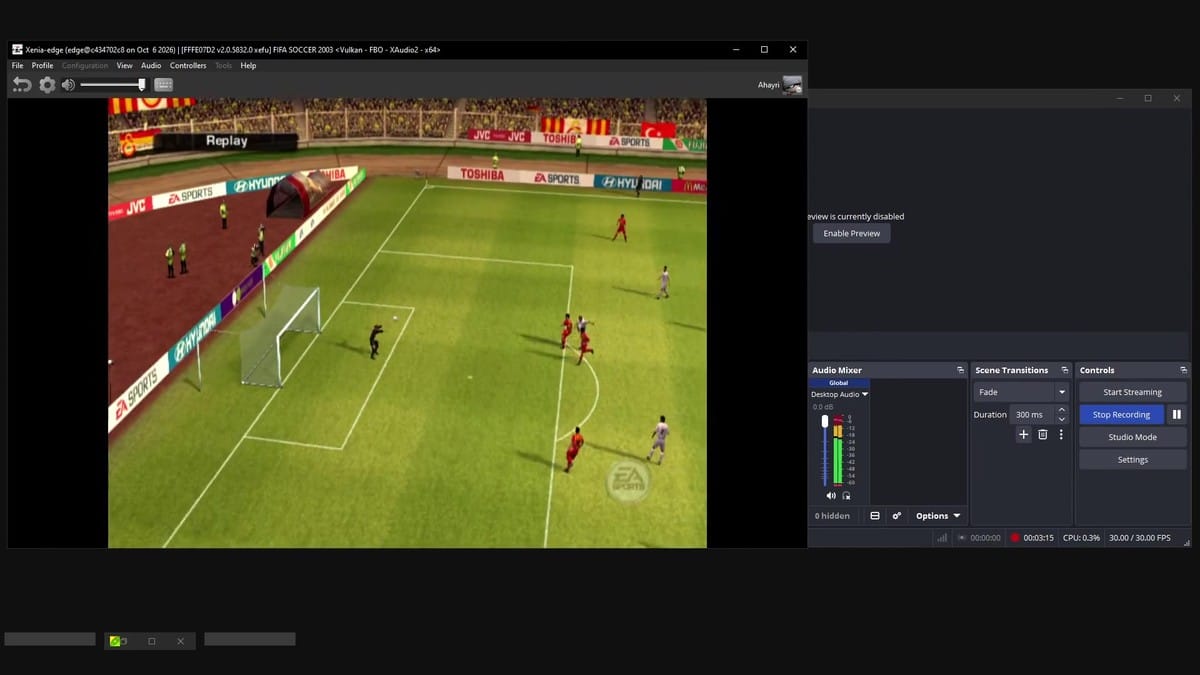
Developer has207's experimental Xbox 360 emulator fork, Xenia Edge, is now running original Xbox games at 60 frames per second using Microsoft's internal backward compatibility layer. The latest builds integrate experimental support for XeFu, the software wrapper the Xbox 360 originally used to play older discs.
According to the Xenia Edge release page, this feature allows the PC emulator to boot original Xbox software by passing it through the 360's native emulation environment. It is essentially emulating an emulator.
Microsoft built Xenon Fusion (commonly called XeFu) into the Xbox 360 to handle a massive architectural gap. The original Xbox was effectively a desktop PC in a plastic shell, featuring a custom Intel Pentium III processor and an Nvidia graphics chip. When Microsoft moved to IBM's PowerPC architecture and ATI graphics for the Xbox 360 in 2005, native hardware compatibility was impossible. They couldn't just run the code natively. XeFu was the software solution.
For years, running XeFu inside open-source PC emulators was blocked by missing kernel exports and complex user-mode execution mechanics. Initial progress on booting XeFu in Xenia forks surfaced around July 2026, and the compatibility has improved rapidly since then.
Two layers of translation
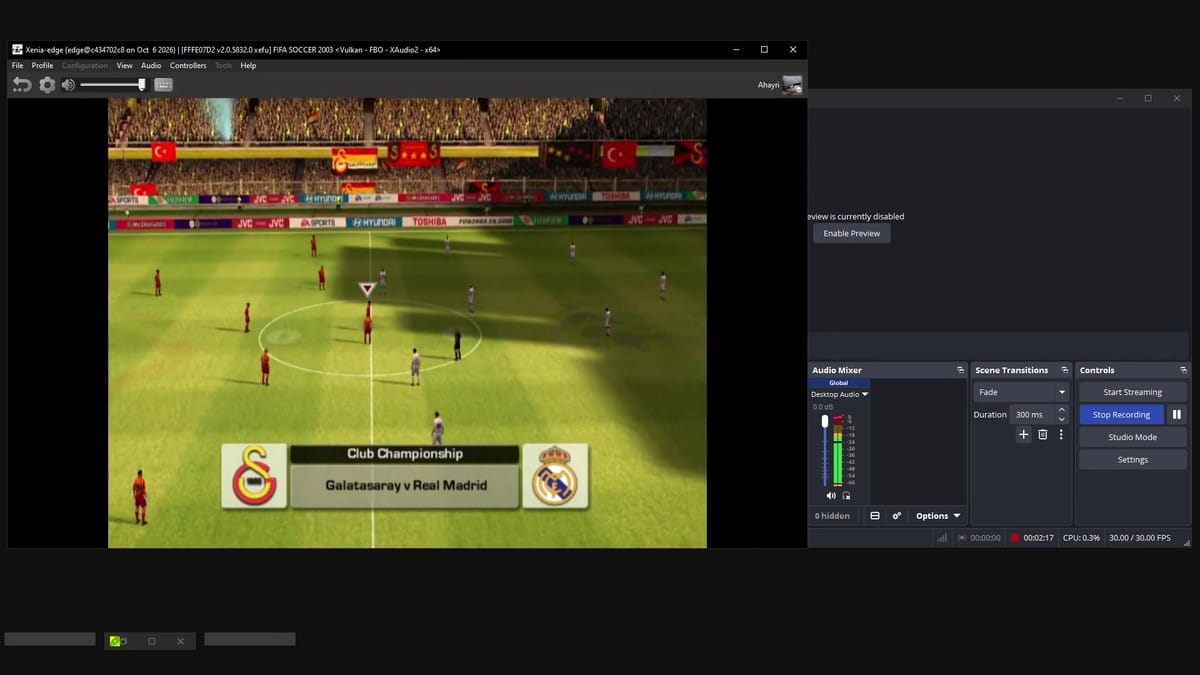
A new performance test from YouTube channel Ahayri demonstrates how far the implementation has come. The video shows EA Sports' FIFA Soccer 2003 running on Xenia Edge build edge1@4054a10. Using the Vulkan rendering backend, the game maintains a stable 60 frames per second at an upscaled 1920x1080 internal resolution.
FIFA Soccer 2003 running on Xenia Edge via XeFu. (Video: Ahayri)
The footage covers the intro cinematic, menu navigation, and a full match between Galatasaray and Real Madrid. The emulation handles the game's 3D models and stadium rendering without obvious visual glitches.
FIFA Soccer 2003 launched in October 2002 for the Xbox, PlayStation 2, GameCube, and PC. It introduced a new ball physics system and the Freestyle Control mechanic, which mapped skill moves to the right thumbstick. Seeing a sixth-generation sports title run this smoothly through a nested emulation layer is a technical milestone for the project.
Emulating the PowerPC architecture of the Xbox 360 is already CPU-intensive. Forcing that emulated PowerPC environment to then translate x86 instructions from an original Xbox game adds a massive amount of computational overhead. The fact that a modern PC can brute-force this nested translation and still output a 1080p image at 60 frames per second shows how far single-thread CPU performance has come.
The compatibility gap
I want to see how this handles the games that Microsoft's official backward compatibility program left behind. The Xbox One and Xbox Series consoles only support a curated list of original Xbox games. Hundreds of titles didn't make the cut due to expired music licenses, dissolved studios, or technical hurdles.
Because XeFu was Microsoft's original solution for the Xbox 360, getting it fully operational inside Xenia Edge could theoretically open up a massive library of early 2000s software. The Xbox 360's backward compatibility list was much larger than the modern Xbox program, supporting over 460 original Xbox games.
The Xenia Edge project focuses on rapid iteration and alternative backend improvements compared to the mainline Xenia codebase. The emulator is available for Windows, and you'll need a relatively modern GPU to handle the overhead of running two nested hardware environments at once. It isn't a perfect replacement for a dedicated original Xbox emulator like xemu just yet, but it's a fascinating alternative path to getting these games running on modern hardware.
Comments ()