
The Nintendo 64 turns 30 and I still have my forged receipt
Thirty years ago, Nintendo dropped a 64-bit Silicon Graphics powerhouse into our living rooms, assuming we could find one.
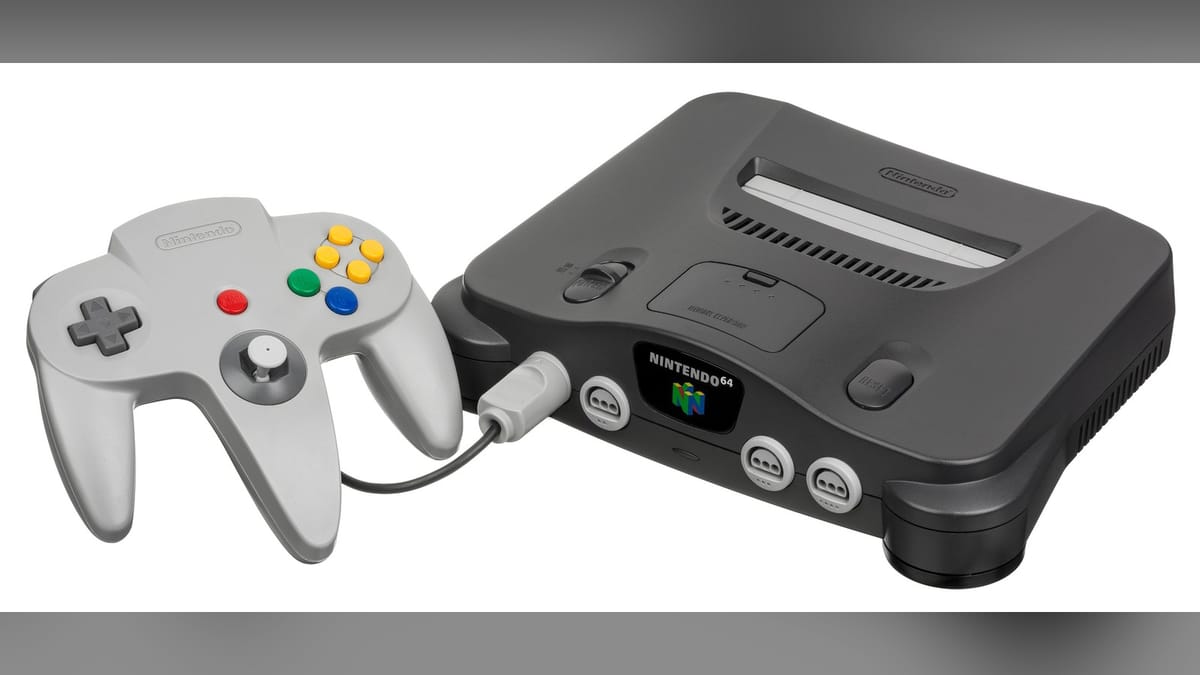
I bought one at launch. I had my pre-order from Toys'R'Us, and I decided to forge the date to a few days before launch and try to get it early. Guess what, it worked! I couldn't believe it. I thought I hacked Toys'R'Us, but later reports reveal that the retailer didn't care. They let people pick it up early. Who would know? It's not like the games were online and phoning home.
The North American launch of the Nintendo 64 on September 29, 1996, was a mess of staggered shipments. Nintendo originally planned a simultaneous global release. Market studies quickly showed demand would outstrip supply, forcing the company to stagger the rollout. They also dropped the price right before release. The console was supposed to be $250. Sony and Sega had lowered the PlayStation and Saturn to $199.99 that summer. Nintendo matched the $199 price tag to combat PlayStation, pricing the new hardware as an impulse purchase.
I felt like I had a Silicon Graphics machine in my living room. Nintendo partnered with SGI to build the Reality Co-Processor, bringing workstation-level hardware to a home console. The system ran on a NEC VR4300 CPU clocked at 93.75 MHz. It used a unified memory architecture with 4 MB of Rambus DRAM out of the box, expandable to 8 MB via the Expansion Pak. The graphics chip provided the direct memory access functionality, arbitrating access for the entire system.
The analog stick changed everything
I couldn't believe how amazing Super Mario 64 was. It changed gaming forever. The analog stick changed everything. Before this, we were locked to eight directions on a D-pad. The controller itself looked like a three-pronged trident, and it included a dedicated Z-trigger underneath the center prong designed specifically for the index finger.
Shigeru Miyamoto and his team spent months perfecting Mario's movement. They tested motion capture but ultimately hand-animated everything from a central skeleton. The development team built 193 different animation patterns for Mario alone. Miyamoto wanted jumping in 3D to feel intuitive rather than quantitative. In older 2D games, players could measure jumps by the pixel. In 3D, the camera angle made that impossible. The team adjusted the physics so that if a jump was close enough, Mario would make it.
The camera system was just as important. A virtual Lakitu followed Mario, giving players manual control over their view of a 3D world. It was a massive departure from fixed perspectives. The game grossed $140 million in the United States during its first three months.
The great software drought
The problem was that there was a delay of releases after that. The console launched with exactly two games in the United States: Super Mario 64 and Pilotwings 64. Cruis'n USA was pulled from the launch lineup at the last minute because it failed Nintendo's quality checks.
My next favourite game was Star Wars Shadows Of The Empire. People now forget how there was a dry spell of new Star Wars content. So this was a huge deal. It filled a massive gap in the release schedule.
The drought was largely self-inflicted. The 64-bit cartridge decision fundamentally altered Nintendo's third-party relationships for decades. Nintendo chose to stick with ROM cartridges instead of optical CD-ROMs. They cited reduced loading times and piracy concerns. Cartridges were expensive to manufacture and severely limited storage space. Major publishers took their massive, cinematic games to the PlayStation. The Nintendo 64 ended up with a relatively small library of 388 games, relying heavily on first-party titles and second-party developers like Rare.
Thirty years later
Nintendo sold nearly 33 million units worldwide. The console was officially discontinued in 2002. It was the last major cartridge-based home console until the Switch arrived in 2017.
The hardware is notoriously difficult to emulate accurately. The Reality Co-Processor relies on custom microcode that balances system resources differently for every game. The video output is also a known bottleneck. Early motherboard revisions can be modified to restore RGB output, but the stock console produces a famously blurry image on modern displays. Some games eventually required the Expansion Pak, a small memory module that doubled the system RAM from 4 MB to 8 MB. Titles like Donkey Kong 64 and The Legend of Zelda: Majora's Mask would display an error screen if you tried to boot them with the standard Jumper Pak installed.
The Nintendo 64 lives on to this day in the Analogue 3d. Thirty years after I walked out of Toys'R'Us with a box I wasn't supposed to have yet, the hardware still commands attention.
Comments ()