
The Minish Cap hits the 3DS with a native dual-screen port
Homebrew developer EstebanPdN has released a native 3DS port of the Game Boy Advance classic, adding widescreen and touch controls.
Homebrew developer EstebanPdN released a native Nintendo 3DS port of The Legend of Zelda: The Minish Cap this week. The project uses the open-source Minish Cap decompilation and the Project Picori engine to run the Game Boy Advance game directly on 3DS hardware without relying on emulation.
Because it runs natively, the port completely overhauls the game's presentation. The top screen displays true 400x240 widescreen gameplay, while the bottom screen handles the map, dungeon information, and touch-based item controls.
A second screen for your map
The developer built this release using the dual-screen Android source base created by samyost1. It includes automatic region detection for USA and European ROMs, along with several display styles including Pixel Perfect, Scaled, and Blur.
If you play on a New Nintendo 3DS, the port automatically taps into the upgraded hardware. It uses the 804 MHz CPU mode, L2 cache, and multi-core rendering to keep the framerate stable. You can even use the C-Stick for a 2x to 5x turbo speed boost.
The older 3DS models get an optimized renderer and an adaptive presentation-skip profile. If the console cannot sustain 60 frames per second, the engine skips visual frames to keep the game logic running at full speed. It beats watching Link run through Hyrule in slow motion.
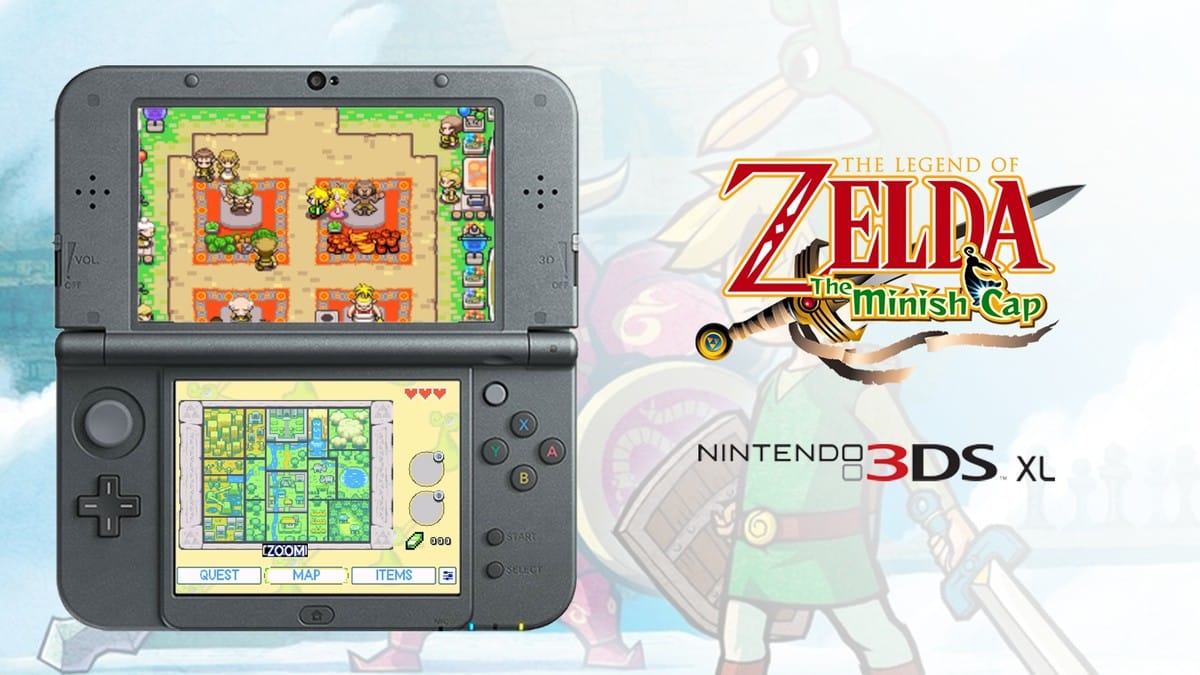
Capcom did it better
The Minish Cap is one of the greatest Zelda games ever made. Nintendo did not actually develop it internally. Capcom's subsidiary Flagship built the game, releasing it for the Game Boy Advance in late 2004 in Japan and early 2005 in North America. It was directed by Hidemaro Fujibayashi, who eventually went on to direct Breath of the Wild and Tears of the Kingdom.
The shrinking mechanic and the talking hat Ezlo gave the game a completely different rhythm than A Link to the Past. Despite being brilliant, it was trapped on the GBA for years. It only surfaced as a 3DS Ambassador exclusive in 2011 and a Wii U Virtual Console release before finally hitting Switch Online in 2023. Moving the inventory to a touch screen is a massive quality of life upgrade.
Bring your own ROM
EstebanPdN is well known in the homebrew scene for creating native 3DS ports of A Link to the Past and Mario Kart 64. As with those projects, this release does not include any copyrighted assets. You have to provide your own legally obtained Game Boy Advance ROM to extract the necessary files.
Source: github.com
Comments ()