
MenuetOS updates add faster secure networking and a Game Boy emulator
A string of 2026 releases for the x86-64 assembly operating system MenuetOS adds faster TLS networking, TrueType fonts, Wizord EXL100, and MenuetBoy.
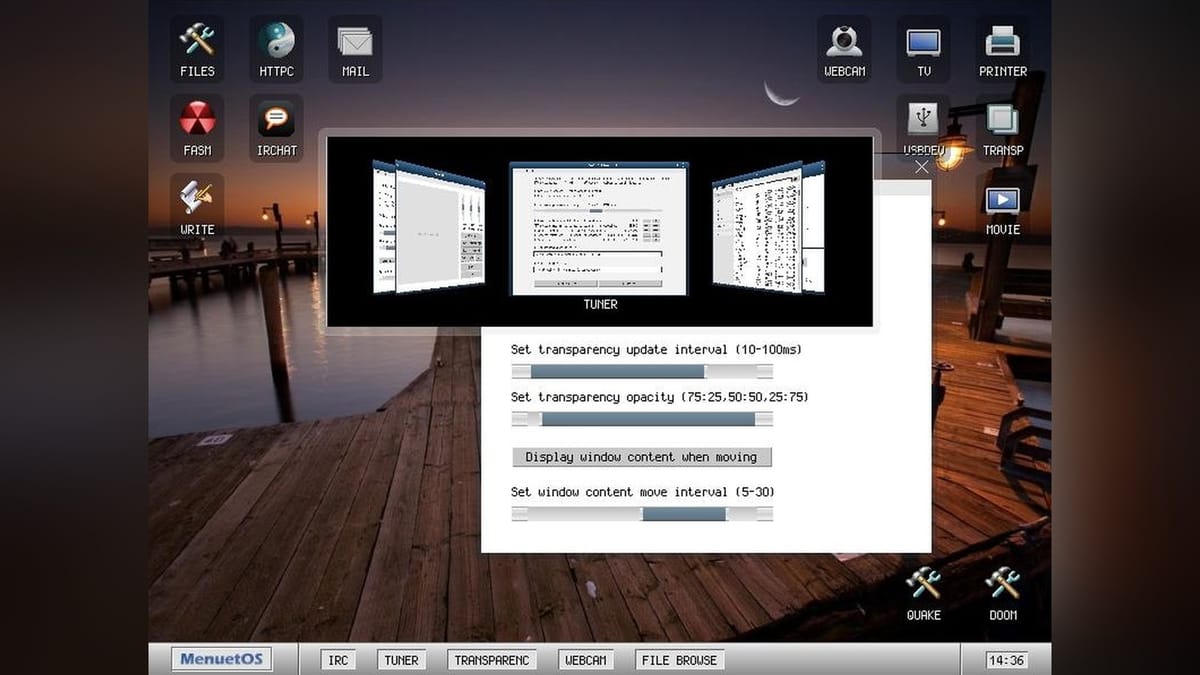
MenuetOS, the PC operating system written entirely in x86-64 assembly language, has rolled through several 2026 point releases culminating in version 1.63.00 on November 11. As noted in a recent OSNews roundup, the updates over the past several months have brought faster secure network connections, expanded hardware drivers, a native TrueType font demo, and a port of the 1985 French computer game Wizord, while November's v1.63.00 release slipped in a Game Boy emulator right behind them.
Rather than landing in one monolithic drop, these additions arrived incrementally on the official MenuetOS downloads page between February and November. Version 1.58.50 on February 15 added more options for driver programming, while spring builds v1.59.60 (April 3) and v1.60.00 (April 10) stabilized Intel HDA audio and the built-in FTP client and server, and expanded API functions across Ethernet, MIDI, audio, and graphics drivers. Version 1.62.20 followed in late October with faster SSL/TLS connections, new window setup system calls (syscalls 100 and 120), and truetype.asm, a native assembly TrueType demo supporting more than 20 fonts.
An EXL 100 shooter and a Game Boy emulator
The gaming additions arrived in two separate builds. Back on June 19, Menuet64 v1.61.00 integrated a port of Wizord by developer Pascal.G. Originally published by Exelvision in 1985 for the EXL 100, an obscure French home microcomputer with a tiny cartridge library, Wizord is a fixed-screen space shooter in the vein of Space Invaders and Galaga. Porting software from a niche 1980s French micro to a closed-source 64-bit assembly OS is an absurdly narrow intersection of computing history, though it fits right in with the hobbyist spirit of the OS.
More recently, v1.63.00 shipped on November 11 with MenuetBoy, a Game Boy emulator written by Bubio that comes bundled with a Sokoban.gb ROM. I'm curious how cleanly MenuetBoy handles commercial ROM timing given the OS's real-time scheduler, which can run between 1,000 Hz and 100,000 Hz.
Still fitting on a 1.44 MB floppy
Finnish developer Ville M. Turjanmaa started MenuetOS in May 2000 as a 32-bit, GPL-licensed project designed without Unix or POSIX roots, aiming to strip away software abstraction layers by writing everything directly in FASM (flat assembler). That 32-bit branch spawned the open-source KolibriOS fork in 2004 and received its final update, v0.86B, in September 2019.
Turjanmaa shifted his focus in 2005 to the 64-bit Menuet64 branch, which uses a proprietary license that remains free for personal and educational use. Despite supporting symmetric multiprocessing across up to 32 CPUs, ring-3 memory protection, 1920x1080 resolution in 16 million colors, USB 1.1 and 2.0 device classes, FAT12/FAT32 filesystems, and a built-in TCP/IP stack, the core system image still fits on a single 1.44 MB floppy disk alongside an optional 80 MB bootable CD ISO.
It runs on standard x86-64 PC hardware (and virtual machines) while keeping backward compatibility for older 32-bit Menuet32 applications. The closed-source license on the 64-bit branch limits outside kernel contributions compared to KolibriOS, and you won't be replacing a daily-driver Linux install with it anytime soon, yet Turjanmaa's steady release pace keeps proving how much capability you can cram into pure assembly.


Comments ()