
The Fairchild Channel F invented the console 50 years ago today
Fifty years ago, Jerry Lawson and Fairchild released the first video game console to use interchangeable ROM cartridges, changing the industry forever.
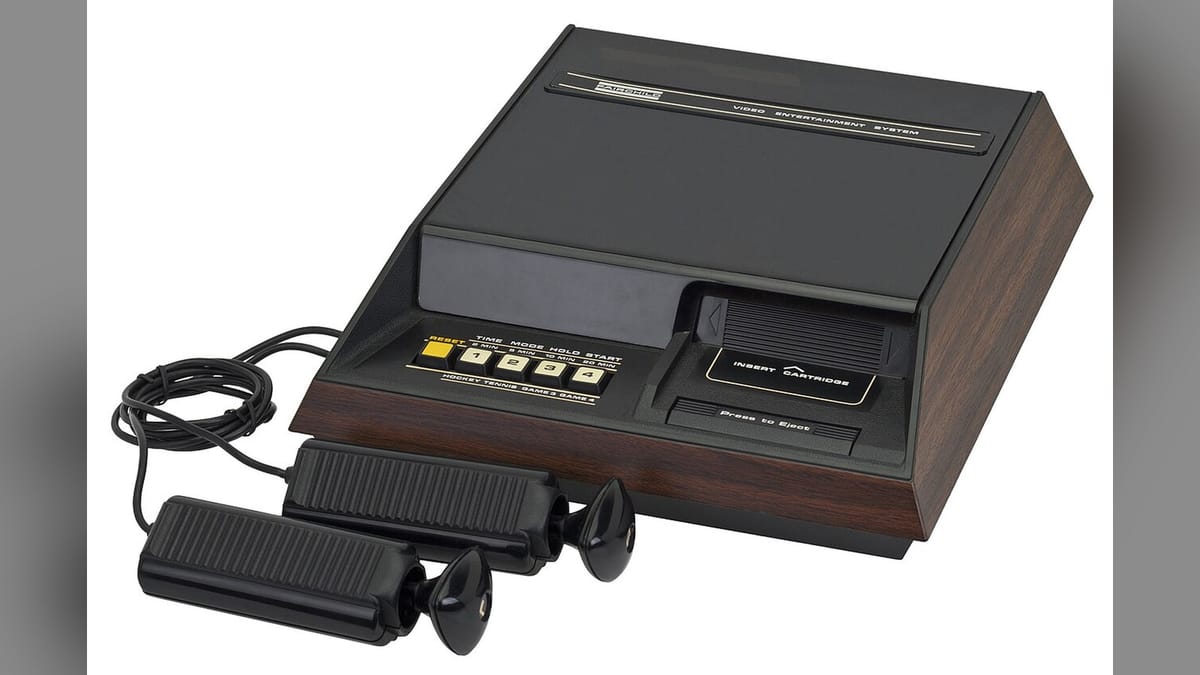
In November 1976, playing a video game at home meant buying a dedicated box that played a single game. You hooked a Magnavox Odyssey or a standalone Pong clone to your television, and the internal circuitry did exactly one thing. The hardware was the software. Fifty years ago today, that changed with the release of the Fairchild Channel F.
The Channel F pioneered the concept of an empty, general-purpose computer that executed interchangeable software stored on ROM cartridges. It was the first home console powered by a microprocessor. Instead of buying a new machine for every game, players bought a $169.95 base unit and swapped out plastic cartridges to play different titles.
The Alpex connection
The origins of this system started in Connecticut. Wallace Kirschner and Lawrence Haskel at the Alpex Computer Corporation invented the raw cartridge mechanism. They built a prototype called RAVEN (Remote Access Video Entertainment) using an Intel 8080 processor. They used EEPROM chips inserted directly into a circuit board to swap games, eventually building crude prototype cartridges out of small plastic boxes from RadioShack.
Alpex lacked the manufacturing capability to mass-produce the system, so they pitched it to Fairchild Camera and Instrument. Fairchild sent an engineer named Jerry Lawson to evaluate the Alpex prototype. Lawson was one of the only Black engineers in Silicon Valley in the 1970s and a member of the Homebrew Computer Club. He had already built his own coin-operated arcade game prototype called Demolition Derby in his garage. Lawson saw the potential in the Alpex design and recommended that Fairchild license the technology.
Not exactly plug and play
Turning a fragile prototype into a consumer product was a massive engineering challenge. Lawson took charge of the engineering and commercialization of the system. He replaced the Intel processor with Fairchild's own F8 microprocessor. The console had just 64 bytes of RAM and a 2 kilobyte video buffer, outputting a resolution of roughly 102 by 58 visible pixels.
Lawson and his team, including industrial designer Nick Talesfore and mechanical engineer Ronald A. Smith, had to refine the raw Alpex mechanism into a durable, shock-proof commercial system. The cartridges needed to survive being jammed into a slot by children without causing static discharge that would fry the microprocessor.
They also had to fight the Federal Communications Commission. The Channel F was the first microprocessor-driven home console ever submitted for FCC certification. The agency had extreme testing requirements to ensure the device would not broadcast interference and disrupt neighborhood television signals. Lawson encased the motherboard in a massive aluminum shield to pass the rigorous radiation tests.
The eight-way controller
The Channel F also introduced a completely new way to interact with games. Lawson designed a revolutionary 8-way multi-axis joystick. Instead of a standard directional pad, the controller was a handgrip shaft with a triangular knob on top. Players could push it in eight directions, twist it, and pull it up or push it down to trigger actions.
The console even featured the first hardware pause button in gaming history. A "Hold" button on the main unit allowed players to freeze the action, a feature that seems standard now but was entirely novel in 1976.
A short retail life
Despite inventing the modern console business model, the Channel F had a short lifespan. It sold about 350,000 units and struggled to compete when Atari released the VCS (2600) a year later in 1977. Atari took the cartridge concept Lawson's team had refined and dominated the market. Fairchild eventually sold the technology to Zircon International in 1979, and the system was discontinued entirely by 1983.
Lawson left Fairchild in 1980 to found Videosoft, an early independent game development studio that created software for the Atari 2600. He passed away in 2011, shortly after being honored by the International Game Developers Association for his pioneering work. His legacy is heavily documented by organizations like the Computer History Museum and archived in detailed historical records like this Vintage Computing and Gaming interview.
Every console that followed used the razor-and-blades model of selling a base system and licensing interchangeable software. The Channel F might not have the cultural footprint of the Atari 2600 or the Nintendo Entertainment System, but it built the foundation they both stood on.

Comments ()