
GOG outlines preservation philosophy and community role in new manifesto
The DRM-free storefront breaks down its approach to keeping classic software alive and why players are the driving force behind the effort.
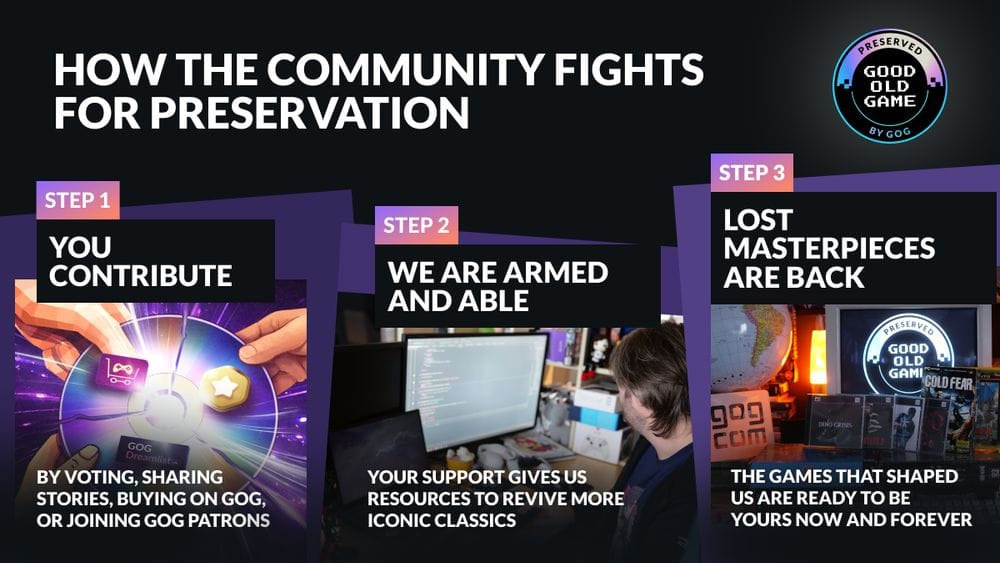
Digital storefront GOG has published a new editorial outlining its internal philosophy regarding game preservation and the critical role the gaming community plays in keeping abandonware from disappearing. The post, titled "Making Games Live Forever," appeared on the company's website earlier today following a social media announcement.
According to the official blog post, the Polish retailer views the gaming community as the "starting point" of all preservation efforts. While the company handles the legal and technical heavy lifting required to bring a thirty-year-old DOS title to Windows 11, they acknowledge that player interest is the primary metric that convinces rights holders to sign off on these projects.
More Than Just a Storefront
For those who only know GOG as the place to buy Cyberpunk 2077 without digital rights management, the company's roots are explicitly tied to software archaeology. Founded in 2008 as Good Old Games, the CD Projekt subsidiary entered the market with a specific goal: making classic PC games playable on modern operating systems without the headache of manual patching or emulator configuration. I personally have a stack of games from GOG. I love that I own them outright. When you purchase a game on Steam or Epic, you are only buying a license to play the game. That license could be revoked! With GOG, like god intended, you own the actual game.
This was a significant gamble in the late 2000s. At the time, piracy was often the only way to play titles like Fallout or Planescape: Torment on Windows Vista. GOG's strategy involved tracking down the often-tangled rights to these properties, stripping out aggressive DRM like SecuROM or SafeDisc, and wrapping the game files in pre-configured instances of DOSBox or ScummVM.
The new blog post reiterates that this process is rarely simple. Preservation isn't just about copying files. It involves reverse-engineering proprietary formats and negotiating with publishers who may not even realize they own the rights to a specific back-catalog title. When a studio closes or is acquired, the intellectual property rights for their games often end up in a legal limbo that can last for decades.
The Technical Hurdle
GOG's emphasis on the community highlights a symbiotic relationship that has defined the retro PC scene for years. Before a game officially lands on the storefront, it is often the community that keeps it alive through fan patches, source ports, and documentation. GOG frequently integrates these community fixes directly into their commercial releases, usually with the permission of the original modders.
This approach stands in contrast to other major digital platforms. While Steam offers a massive library of older titles, Valve generally acts as a neutral marketplace. If a publisher uploads a raw executable from 1998 that crashes instantly on Windows 10, it typically stays that way until a user digs through the forums for a fix. GOG's value proposition has historically been the curation and quality assurance that ensures the game actually launches.
The Offline Factor
The timing of this manifesto is relevant to the current industry climate. We are seeing an increase in live-service games shutting down and rendering physical discs useless. GOG remains one of the few major retailers offering offline installers for every game in its library. This allows users to back up their purchases to a physical hard drive, ensuring access even if GOG's servers eventually go dark.
This distinction is what separates commercial preservation from mere distribution. By providing the standalone files, the company effectively hands the responsibility of long-term archival back to the user. It is a model that relies heavily on trust, but it is also the only model that guarantees a game purchased today will still be installable in 2050 regardless of the storefront's corporate fate.
You can read the full breakdown of their preservation stance on the GOG website.
Comments ()