
Anbernic's new RG DS Plus brings pixel-perfect dual screens to Linux
Anbernic is updating its clamshell retro handheld with exact 4x integer scaling for Nintendo DS games and a custom Linux operating system.
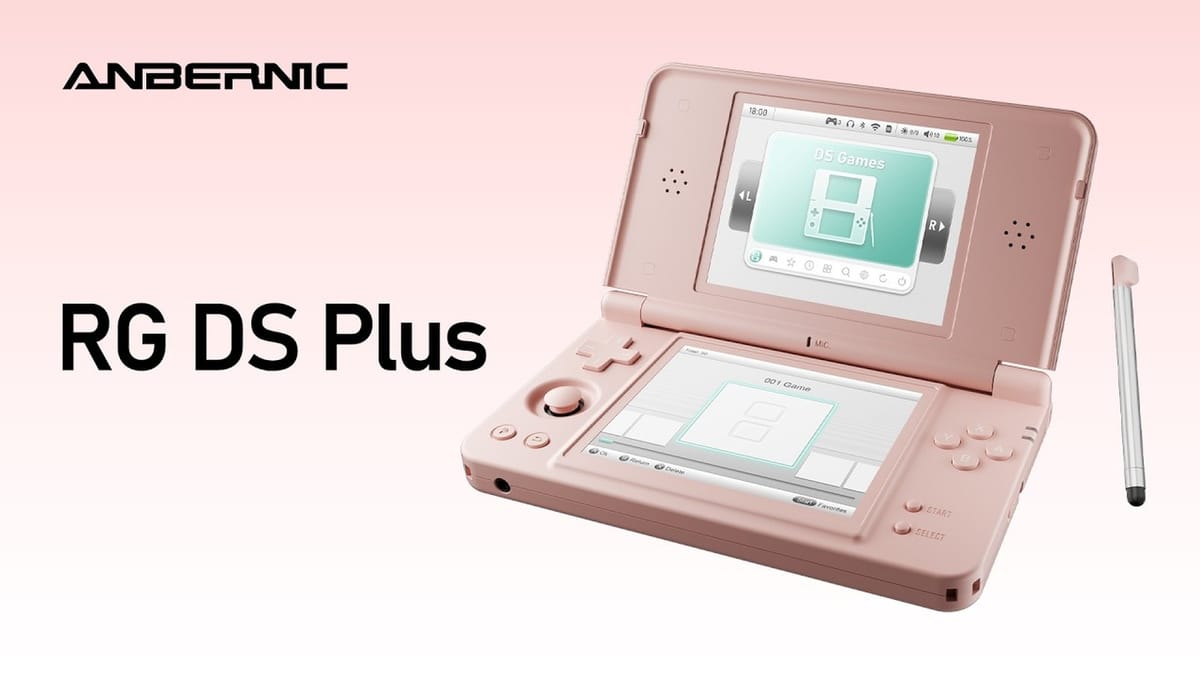
It has a built in stylus!
Retro hardware maker Anbernic has announced the RG DS Plus, a revised clamshell handheld featuring dual 4.3-inch screens and a custom Linux operating system. The device is a direct follow-up to the company's previous dual-screen effort, aiming to fix the display scaling issues that plagued the first model.
The original RG DS launched in late 2025. It ran Android 14 on a Rockchip RK3568 processor and used dual 4.0-inch 640x480 displays. That first attempt was a missed opportunity. The 640x480 resolution resulted in an awkward 2.5x scaling ratio for Nintendo DS emulation, making games look slightly blurry or uneven. It was a fun novelty to have a clamshell again, but it did not provide the crisp visuals you want from a dedicated retro device.
The math finally works
The RG DS Plus solves the scaling problem by upgrading both panels to 4.3 inches with a resolution of 1024x768. According to the official announcement trailer, this provides exact 4x pixel-perfect integer scaling for native Nintendo DS titles, which originally rendered at 256x192 per screen. It also delivers a 16-in-1 pixel density, meaning the games will look incredibly sharp without any weird artifacting.
The official reveal trailer for the Anbernic RG DS Plus.
The physical hardware is getting an overhaul as well. The new model features redesigned dual alloy hinges that support stepless positioning anywhere from 15 to 180 degrees. It includes a built-in stowable capacitive stylus for bottom-screen touch controls, standard face and shoulder buttons, an analog slider, and micro-SD storage expansion. Anbernic is offering the device in three colors: pink, dark blue, and black.
Ditching Android for Linux
Anbernic is moving away from Android for this revision. The RG DS Plus runs a custom Linux OS built around NNOSS, a proprietary dual-screen emulator. The software supports screen swapping, real-time clock functionality, microphone input, cheat codes, and instant save states. It also packs 76 built-in shaders so you can tweak the visual output.
Comparing the RG DS Plus to the AYN Thor highlights two completely different approaches. The Thor is another recent dual-screen clamshell, but it is a premium, heavy device with massive 6-inch AMOLED displays and a high-end Snapdragon processor running Android. The Thor can emulate everything up to the Switch, but it is expensive and weighs nearly 400 grams. The RG DS Plus is aiming for a much more focused experience. It is a lighter, Linux-based handheld dedicated entirely to getting Nintendo DS emulation right on a pixel-perfect screen, rather than trying to be a pocket-sized supercomputer.
Nintendo released the original DS in 2004. Its unique dual-screen layout and touch controls have always made it a headache to emulate on standard single-screen devices. You usually have to put the screens side-by-side or map a button to toggle between them. Anbernic has been building retro handhelds since 2017, mostly focusing on standard vertical and horizontal designs. Hardware like the RG DS Plus shows that manufacturers are finally building dedicated clamshells to solve the dual-screen emulation problem natively.

Comments ()