
3D Vectrex racer Shockwave hits Kickstarter and clears its goal
Roger Boesch's WipEout-inspired wireframe racer uses a custom RP2350 cartridge to run real-time 3D on an unmodified 1982 Vectrex, with a PC version also coming.
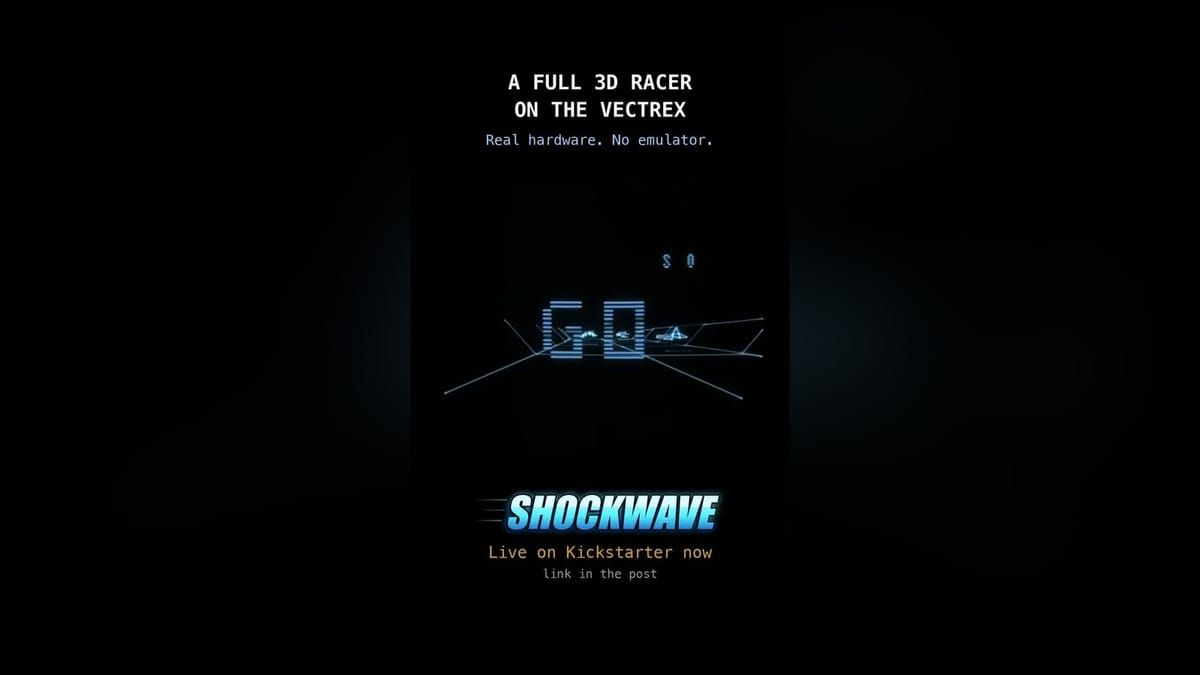
Zurich-based developer Roger Boesch has launched a Kickstarter campaign for Shockwave, a full 3D anti-gravity racing game built for the original 1982 Vectrex console and PC. The campaign opened on November 17, runs until December 17, 2026, and blew past its 12,000 CHF (about $14,279 USD) goal within 48 hours.
As of November 19, over 170 backers have pushed the total past 21,009 CHF (roughly $25,034 USD), following a spotlight post from the official Vectrex Bluesky account. That early surge has already unlocked stretch goals for two-player split-screen multiplayer, a Mirror Mode, and a browser-based track editor.
Boesch first revealed Shockwave on January 25, 2026 in his Vector & Vertex newsletter post "The Transition to LineForge and Beyond," followed by a dedicated post and downloadable proof-of-concept five days later on January 30. Inspired by 1995's PlayStation racer WipEout, the game puts eight ships across four teams onto seven wireframe circuits with real-time 3D racing physics. Seeing WipEout-style tracks bend and bank in glowing vector lines on a vertical 9-inch CRT feels slightly surreal, and I'm curious how readable the track edges stay once split-screen cuts that small display in half.
An RP2350 chip inside the cartridge
A stock 1982 Vectrex and its Motorola 68A09 processor weren't built to calculate real-time 3D anti-gravity physics on their own. Boesch's previous Vectrex game, the Zaxxon-inspired isometric shooter VEXXON (released in July 2026), got around the system's limits by requiring a PiTrex, a Raspberry Pi Zero cartridge-slot adapter that isn't cheap or easy to find.
Shockwave drops that extra hardware requirement. Detailed by Boesch on July 27, 2026, the game's custom Rev A smart cartridge puts a Raspberry Pi RP2350 microcontroller right on the board. The onboard chip handles the 3D wireframe math and drives the Vectrex's electron beam directly, so the cart plugs straight into an unmodified console like any original release.
Boesch brings more than 30 years of software engineering experience to the project, spanning NeXTSTEP, mobile development, and spatial computing work at Magic Leap. Before Shockwave and VEXXON, he built the VectreC C cross-compiler toolchain and wrote the 230-page programming book Vectrex Mastery.
44 years of glowing lines
Developed by Smith Engineering and launched by General Consumer Electronics in late 1982 for $199, the Vectrex is still the only commercial home console with a built-in monochrome vector CRT monitor. Milton Bradley bought GCE and killed the hardware in January 1984 during the video game crash, leaving plastic screen overlays and built-in Mine Storm as relics of a very brief commercial run.
The platform's active homebrew scene goes back to the mid-1990s. Hardware creator Jay Smith and Smith Engineering kept their intellectual property rights (while Neo Retro / Data Access owns the Vectrex trademark), but Smith granted permission for fee- and royalty-free new hardware and software development alongside non-profit reproduction. With Neo Retro's modernized Vectrex Mini also slated for early 2027 after a November 21 London showcase, the 44-year-old hardware is having an unusually busy season.
Cartridge tiers and a 2027 Steam release
You don't actually need a working 1982 CRT on your desk to play it. Alongside the physical Vectrex release, Roger Boesch Games is bringing a standalone desktop edition to Steam in 2027, and a 10 CHF (about $12 USD) tier backs the project digitally.
Physical cartridges are scheduled to ship in August 2027. A loose cart runs 59 CHF (around $70 USD), and the 89 CHF (around $106 USD) boxed edition adds a screen overlay, manual booklet, and personalized pilot serial number, with both physical tiers including a Steam key. Nearly $106 for a homebrew game isn't pocket change, though packing an RP2350 board, a custom shell, and a fresh plastic overlay into a small manufacturing run makes the math easy enough to understand.
Comments ()